Jewelry for Chronic Illness: Hypoallergenic, Easy-Close, and Beautiful for Every Kind of Day
The content on this site was created with the help of AI. LOVEOWE LLC participates in the Amazon Services LLC Associates Program and other affiliate programs. As an Amazon Associate, I earn from qualifying purchases. This means I may earn a small commission—at no extra cost to you—when you make a purchase through links on this site. All opinions are my own. Learn more click here. Thank you for your support!

Because looking adorned shouldn’t cost you anything extra
For almost two years I stopped wearing earrings. Not because I stopped wanting to — I have always been someone who feels more like herself with something at her ears, something at her wrists, something that signals intention about how she’s moving through the world that day. I stopped because the process of putting them in had become a negotiation I was losing. The tiny backs, the pressure required to push through the hole, the precise grip my fingers could no longer reliably produce. I would get one in and my hands would give out before the second. Or I’d drop the back and spend ten minutes on the floor that I didn’t have. Eventually I stopped trying.
What I didn’t understand then was that the problem wasn’t jewelry. It was the specific format of jewelry I’d been wearing — clasps and closures and mechanisms designed for hands that work without interruption, for fingers that grip and turn and pinch without negotiating with pain first. Once I started looking for jewelry that was designed differently — or that could be worn differently — the whole category opened back up.
There was also the skin piece. Several of my medications had made my skin reactive in ways it never was before — metals that had never bothered me were suddenly leaving green marks, raised patches, the particular itch of a contact reaction that doesn’t go away until you remove the offending piece and sometimes lingers for days after. Learning which metals were safe for my skin and which weren’t was its own education, and one that most jewelry marketing doesn’t make easy.
This post is for anyone who has quietly put their jewelry away and hasn’t yet found the path back to it. The pieces that work for sensitive skin, limited dexterity, fluctuating swelling, and the kind of days where you need getting dressed to be simple but still want to feel like yourself when you look in the mirror. That version of adornment exists. It just requires knowing where to look.
Hypoallergenic metals that won’t fight your skin
The relationship between chronic illness and skin reactivity is well-documented but rarely discussed in the context of jewelry specifically. Medications — particularly immunosuppressants, biologics, and certain pain medications — can alter skin sensitivity and increase reactivity to metals that were previously tolerated without issue. Conditions like lupus, psoriatic arthritis, and MCAS bring their own skin involvement. And the general state of immune system dysregulation that characterizes many chronic illnesses means that the body’s threshold for reacting to environmental triggers, including metal contact, is often lower than it would be in a healthy system.
The metals that tend to cause reactions — nickel chief among them, but also cobalt, copper, and certain alloys used in costume jewelry — are pervasive in mainstream jewelry because they’re inexpensive and workable. The metals that don’t cause reactions are more expensive but increasingly available: surgical-grade stainless steel, titanium, sterling silver, solid gold, and niobium are the primary options. Knowing which category your skin falls into is the beginning of building a jewelry collection that you can actually wear.
One practical note: “hypoallergenic” as a marketing term has no regulatory definition, which means it can be applied to almost anything. What you want to look for specifically is the metal composition — the actual material, not the marketing descriptor. The options below are all verified by their actual metal content, not just their labeling.
Hypoallergenic jewelry for sensitive skin

Titanium is one of the most biocompatible metals available — it’s what surgical implants are made from, which tells you everything you need to know about its safety for reactive skin. A set of titanium studs in multiple sizes gives you the versatility of a stud wardrobe without the nickel exposure that makes most affordable stud sets unwearable for sensitive skin. Look for sets that include both screw-back and push-back options, since screw-backs are more secure but push-backs are easier to manage with limited dexterity.

Sterling silver (marked 925) is well-tolerated by most people with metal sensitivities, with the exception of those who react specifically to silver — which is less common than nickel reactivity. Thin-gauge hoops are the right choice for chronic illness wear because their light weight doesn’t pull on the ear lobe over a full day of wearing, and the simple open-hoop format is one of the easiest to put in and remove without fine motor precision. Look for a hinged or click-close closure rather than a fish hook, which requires more dexterity to secure.

Gold-filled jewelry contains a thick layer of real gold bonded to a base metal — unlike gold-plated pieces, which have a much thinner layer that wears off and exposes the base metal beneath. For sensitive skin, gold-filled is the accessible middle ground between solid gold and plated jewelry: it behaves like solid gold for most skin types, lasts significantly longer than plated pieces, and sits at a price point that’s realistic for building a wearable everyday collection.

Internally threaded flat back earrings — where the post screws into the back of the earring rather than the front — were originally designed for body piercing and have crossed over into everyday jewelry for people who find traditional earring backs impossible to manage. The flat back sits flush against the earlobe with no protruding post, which means no sharp point pressing into your neck, no back to find when it falls off, and a significantly easier process for people with limited finger grip. Surgical steel is nickel-free and safe for reactive skin.
Easy-close clasps and closures that work with your hands
The jewelry industry has one dominant assumption built into almost every piece it produces: that the person wearing it has full, reliable use of both hands and all ten fingers. Lobster clasps require you to compress a small spring mechanism with one finger while simultaneously threading a jump ring with the other hand. Standard earring backs require a precise pinch grip. Toggle clasps need two hands working in coordination. Barrel clasps are threaded and require rotation. Every one of these is a fine motor task that chronic illness — through joint inflammation, nerve damage, hand weakness, tremor, or simple pain — can make difficult to impossible.
The solutions exist. They just require knowing what to look for — and in some cases, knowing what can be swapped out. A jeweler can replace a lobster clasp with a magnetic clasp on almost any necklace or bracelet for a small fee. Earring backs can be swapped for larger, easier-to-grip versions. And there is a growing category of jewelry designed from the ground up with accessible closures — worth knowing about whether you’re building a new collection or adapting what you already have.
The goal is not to compromise on beauty. It’s to stop letting a closure mechanism be the reason you’re not wearing the pieces you love.
Easy-close jewelry and closure solutions

A magnetic clasp closes with a satisfying snap when the two ends come near each other — no threading, no compression, no coordination between two hands required. For necklaces specifically, this is one of the most significant functional upgrades available for people with limited hand dexterity. Look for neodymium magnet closures rather than weaker ferrite magnets, which may not hold reliably under the weight of a heavier chain or pendant. Note that magnetic clasps are not suitable for anyone with a pacemaker or implanted medical device.

A magnetic clasp converter is a small finding that replaces an existing lobster or box clasp on a bracelet with a magnetic closure — transforming a piece you already own into something you can put on and take off with one hand. These come in gold, silver, and rose gold finishes to match existing hardware, and installing them requires only opening two jump rings, which a jeweler can do in minutes or which you can do at home with the right tools. Worth having a set on hand for any bracelet in your collection that you’ve stopped wearing because the clasp defeated you.
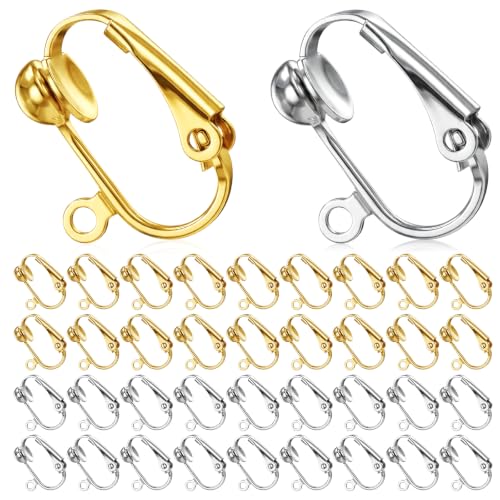
Clip-on earring converters attach to the back of any standard stud or drop earring and convert it into a clip-on — completely eliminating the need to thread anything through a piercing. This is useful for days when ear sensitivity or inflammation makes the piercing itself uncomfortable, for people who find earring backs impossible to manage, or for anyone who wants to wear a favorite pair without the physical process of traditional earring wear. The silicone pad versions are the most comfortable for all-day wear.

Large rubber or silicone earring backs — sometimes called “safety backs” or “guardian backs” — are significantly easier to grip and manipulate than the standard small metal butterfly backs that come with most earrings. They also hold more securely, which means less time spent searching for a back that’s fallen somewhere in the couch cushions. A pack of these costs almost nothing and makes every pair of studs you already own easier to wear on difficult hand days.
Getting dressed with chronic illness — including the small decisions like which jewelry you can actually wear today — is part of a larger negotiation between who you are and what your body allows on any given day. Say This: 30 Scripts for Chronic Pain Communication gives you language for the harder parts of that negotiation: how to explain to people why you look different from one day to the next, how to talk to your care team about symptoms that affect your daily functioning, and how to advocate for yourself in the moments that matter. Get your copy here →
Lightweight pieces for swelling, fatigue, and sensitive days
Two things that chronic illness does to jewelry wear that don’t get discussed enough: the weight problem and the swelling problem. Both are invisible to people who don’t experience them, and both have real solutions once you know what you’re looking for.
The weight problem is about fatigue. Heavy earrings pull on the ear lobe and create a low-grade, constant tension that is negligible to someone whose nervous system is not already managing a pain load — and genuinely exhausting to someone whose is. By the end of a long day, heavy earrings can contribute to neck tension, headaches, and the particular fatigue that comes from a body managing too many small inputs simultaneously. Lightweight metals, resin, and acrylic offer the visual impact of statement jewelry without the physical weight.
The swelling problem is about fit. Ring size, bracelet circumference, and even necklace length can all change meaningfully over the course of a single day for someone managing inflammatory conditions. A ring that fits in the morning can be impossible to remove by evening. A bracelet that was comfortable when you put it on becomes a compression issue as the day progresses. Adjustable pieces, open-band rings, and designs with built-in accommodation for fluctuation solve this in a way that fixed-size jewelry cannot.
Lightweight and adjustable jewelry for fluctuating symptoms

Acrylic and resin earrings deliver the visual impact of a statement piece at a fraction of the weight of metal equivalents — often under two grams per earring, compared to ten or more for similar-sized metal drops. For anyone who loves earrings but has had to give up longer styles because of the neck and shoulder tension they cause, this category is worth revisiting. The color and pattern options in resin have expanded significantly, with options that photograph beautifully and look anything but medical or compromise-driven.

An open-band ring — a ring with a gap at the back that allows the diameter to be adjusted by gently pressing or opening the band — is the most practical ring format for anyone whose finger size fluctuates with swelling. It accommodates the morning-to-evening size change without becoming a tourniquet, and can be adjusted across a range of sizes as your symptoms shift day to day. Look for a sturdy enough gauge that the band holds its shape between adjustments rather than deforming with regular wear.

A sliding knot bracelet adjusts to any wrist circumference by pulling the cord ends — no clasp, no closure, no size commitment. For wrists that fluctuate in circumference throughout the day or week, this is one of the most practical bracelet formats available. Waterproof cord options mean you can wear it through washing, bathing, and all the hand-hygiene demands of chronic illness management without removing it — which eliminates the put-on-take-off dexterity cost entirely.

Titanium rings are among the lightest metal rings available, hypoallergenic, and sized to accommodate the kind of everyday wear that includes hand washing, medication handling, and all the physical tasks chronic illness management involves. Silicone rings offer even more accommodation — they stretch slightly with swelling, can be cut off safely in a medical emergency, and are completely non-reactive to all skin types. Both are worth having as everyday wear options that don’t require you to size up, take off, or worry.
Low-maintenance and semi-permanent options for the days getting dressed is already enough
There is a category of jewelry wear that doesn’t get nearly enough credit in the context of chronic illness: the set-it-and-forget-it approach. Pieces that go on and stay on — through sleep, through bathing, through the days when the idea of adding a single additional step to getting ready is genuinely too much — are not a compromise. They are a strategy.
Permanent jewelry — fine chain welded at the wrist or ankle by a jeweler — has grown significantly in popularity and accessibility. It requires one appointment, no clasp, no daily decision, and looks intentional and beautiful in a way that explains itself to no one. It is also, practically speaking, one of the most accessible jewelry formats for chronic illness because once it’s on, it requires nothing from you.
Short of permanent jewelry, there are pieces designed for long wear — implant-grade titanium earrings that are safe to sleep in, waterproof chains that survive everything, simple rings that don’t need to come off. Building a small collection of these means you’re adorned on every day, including the ones where the most you can do is get out of bed.
That version of looking like yourself — effortless not because it requires no thought but because the thought has already been done — is available. And it’s worth building toward.
Low-maintenance and long-wear jewelry options

Implant-grade titanium earrings with flat backs are specifically designed for continuous wear — they’re the standard in professional piercing studios for initial healing and are safe to sleep in, shower in, and wear through everything. A set of small titanium studs in various profiles gives you an always-in earring rotation that requires no daily decision and no dexterity. Once in, they stay until you choose to change them — which on a chronic illness timeline might be days or weeks.
A fine gold-filled chain necklace with a small clasp that’s easy enough to manage is the accessible version of the permanent jewelry trend — it stays on through showering, sleeping, and daily wear without tarnishing or reacting with skin, and looks effortlessly styled in a way that reads as intentional rather than unchanged. Gold-filled chains in 14–18 inch lengths layer well and photograph beautifully, which matters if you create any content around your life and want to look consistently put-together without consistently trying.

An anklet is one of the lowest-dexterity jewelry options available — it goes on the ankle, where visibility is lower, closures are easier to manage at that angle, and swelling is less likely to make it uncomfortable than a wrist piece. A fine chain anklet in gold fill or sterling silver reads as a considered style choice and stays out of the way of everything else you’re managing. For days when the rest of your jewelry feels like too much, an anklet means you’re still adorned.
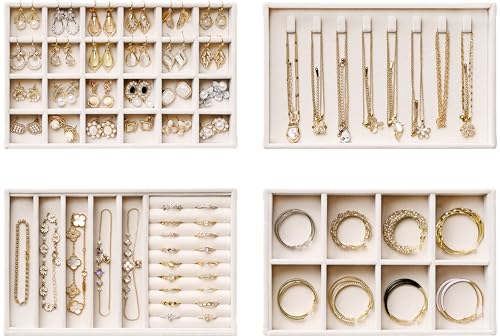
A velvet-lined jewelry tray with open, visible compartments is the organizational piece that makes a low-dexterity jewelry practice actually work. When you can see everything at a glance — no opening boxes, no untangling from a jewelry tree, no digging through a drawer — the daily decision of what to wear requires nothing from your hands before you’ve even started. Separate compartments for earrings, rings, and bracelets mean each piece is accessible individually without disturbing the rest. This is brain fog management and dexterity management in one small object.
You don’t have to earn the right to feel adorned
Jewelry is a small thing in the context of chronic illness. There are larger battles — the medical ones, the advocacy ones, the daily negotiations with a body that doesn’t always cooperate. It would be easy to put jewelry in the category of things that don’t matter right now, things you’ll return to when you’re better, things that are frivolous given everything else.
But I’d push back on that, gently. The version of yourself that wears something at her ears, something at her wrist, something that was chosen with intention even on a Tuesday when everything is hard — that version is not more frivolous than the version that has given up on it. She’s more whole. She’s practicing the belief that she is worth adorning even today, even like this, even in a body that requires accommodations.
That belief is not small. It is, in fact, one of the foundational things that chronic illness tries to take from you — the sense that you are still someone who deserves beauty, effort, adornment. The right earring back doesn’t restore that belief on its own. But choosing to look for it, choosing to build a collection that works for the hands and skin and days you actually have, is a practice of self-worth that compounds over time.
You don’t have to earn the right to feel adorned. You already have it. The jewelry just needs to catch up.
If chronic illness has quietly taken things from you — the jewelry you stopped wearing, the version of yourself you stopped performing, the daily rituals that felt like too much — Say This: 30 Scripts for Chronic Pain Communication was written for the work of reclaiming them. Thirty scripts for the conversations that make reclamation possible: with your care team, with the people in your life, and with yourself. Get your copy here →