Decor Hacks to Maximize Style & Functionality in Small Kitchens
The content on this site was created with the help of AI. LOVEOWE LLC participates in the Amazon Services LLC Associates Program and other affiliate programs. As an Amazon Associate, I earn from qualifying purchases. This means I may earn a small commission—at no extra cost to you—when you make a purchase through links on this site. All opinions are my own. Learn more click here. Thank you for your support!
There’s a unique frustration that comes with small kitchen living—the feeling that you have to choose between having a functional cooking space or a beautiful one, between storing everything you need or having any counter space at all. I lived with a 6×8 kitchen for four years, convinced that its tiny footprint meant I’d never have both style and functionality. Then I visited a friend whose kitchen was even smaller than mine but somehow felt spacious, organized, and genuinely beautiful.
The difference wasn’t square footage—it was strategic choices. She’d implemented simple hacks that maximized every inch: magnetic knife strips freed drawer space, hanging racks created vertical storage, and clever color choices made the room feel twice its actual size. That visit changed my entire approach to small kitchen living. I realized that small kitchens aren’t limitations—they’re opportunities to get creative, intentional, and surprisingly stylish.
The best small kitchen hacks serve dual purposes: they solve storage problems while improving aesthetics, create functionality while adding visual interest, and make spaces feel larger while working harder. This guide shares proven decor hacks that transform cramped, cluttered small kitchens into efficient, beautiful spaces you’ll actually enjoy using.
Understanding Small Kitchen Challenges
Small kitchens face specific challenges that larger spaces don’t encounter. Limited counter space means nowhere to prep food. Minimal storage creates visible clutter. Narrow layouts make moving around difficult. Dark corners and limited natural light make spaces feel even smaller.
Successful small kitchen design addresses these challenges simultaneously rather than treating them separately. The best solutions provide storage while creating visual spaciousness, add functionality while improving aesthetics, and maximize utility while maintaining style.
The key is thinking vertically and creatively—using walls, ceilings, cabinet backs, and other overlooked spaces. Every surface becomes potential storage or display. Every decorative choice should ideally serve function too.
Vertical Storage: Using Wall Space Strategically
Walls represent your small kitchen’s greatest untapped potential. Converting vertical surfaces to functional storage dramatically increases capacity without sacrificing floor space.
Floating Shelves for Display and Storage
Install floating shelves where upper cabinets don’t exist or replace upper cabinets entirely with open shelving. This creates visual lightness (unlike solid cabinets that close in small spaces) while providing accessible storage.
Style shelves with frequently-used items—everyday dishes, glasses, mugs, spices, oils. The items you reach for daily deserve accessible, visible storage. This eliminates digging through cabinets while creating curated display aesthetics.
Choose shelves in wood or metal that complement your kitchen’s style. Keep shelving depth appropriate for wall space—typically 10-12 inches works beautifully without protruding excessively.
Pegboards for Customizable Organization
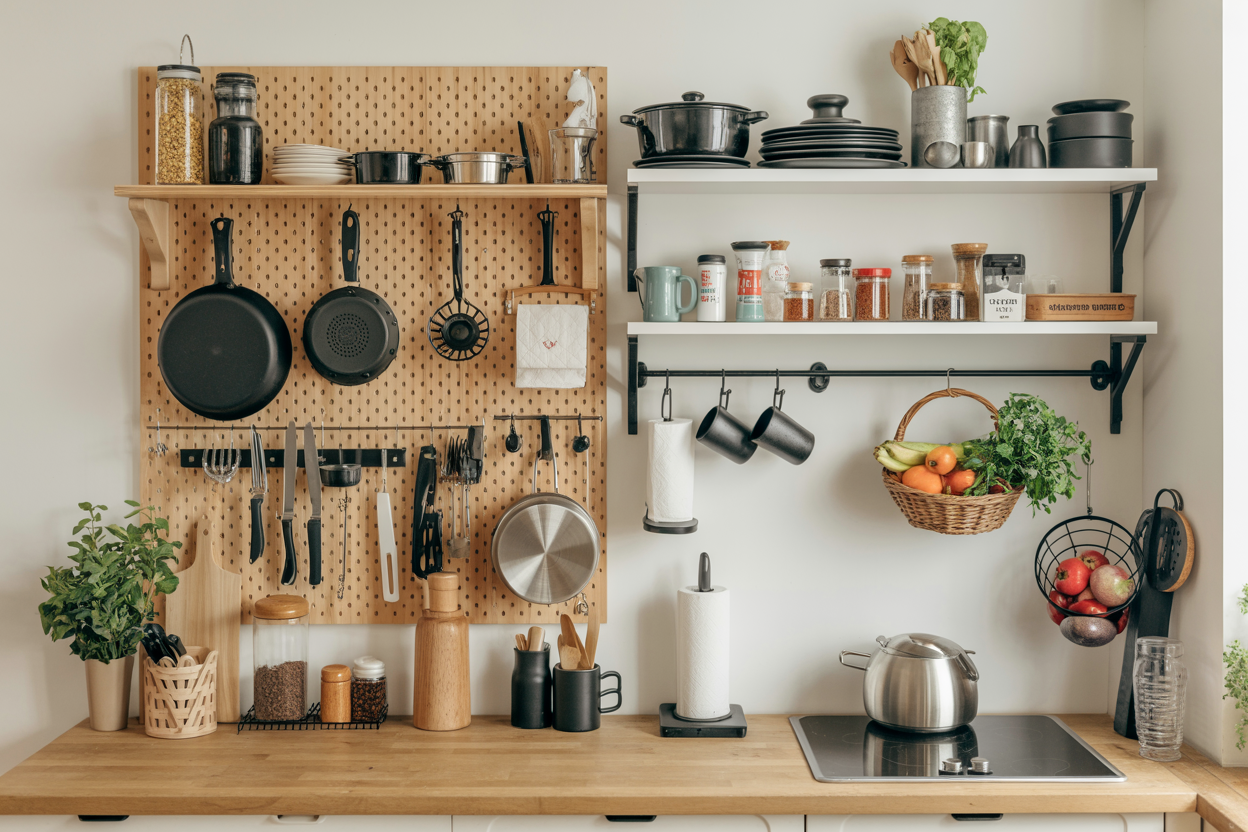
Mount pegboards on empty walls for completely customizable storage. Rearrange hooks, shelves, and baskets as needs change. Hang pots, pans, utensils, cutting boards, dish towels, or small appliances.
Paint pegboards to match walls for cohesive aesthetics, or choose contrasting colors for statement impact. The geometric pattern adds visual interest while serving serious functional purpose.
Magnetic Strips for Knife and Tool Storage
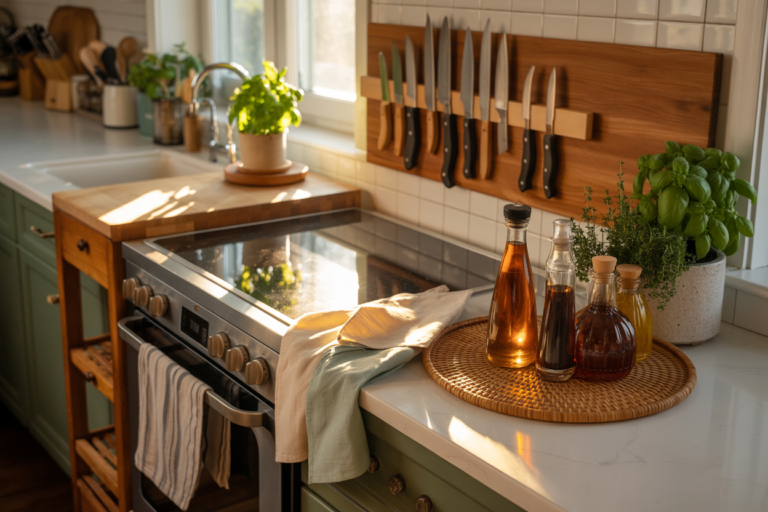
Install magnetic knife strips on walls or backsplash areas. This frees premium drawer space while keeping knives safely stored and easily accessible. The vertical mounting takes up minimal space while displaying beautiful knife collections.
Magnetic strips also hold metal utensils, scissors, measuring spoons, or other metal tools. This versatile storage solution works wherever you have a few inches of wall space.
Rail Systems with Hanging Hooks
Mount horizontal rails (often called S-rails or rod systems) below upper cabinets or along empty walls. Hang S-hooks from rails for flexible storage of utensils, pots, pans, or baskets.
This creates highly accessible storage that’s endlessly reconfigurable. Slide hooks along rails to accommodate different tools or change organization as needs evolve.
Shop Vertical Storage Solutions
IKEA KUNGSFORS Wall Shelf $25 – $50
Sturdy stainless steel, modular system, multiple configurations.
West Elm Industrial Metal Shelving $149 – $249
Quality construction, open design, substantial storage.
The Container Store Pegboard Panel $30 – $60
Customizable, various colors, includes hooks and accessories.
Yamazaki Tower Magnetic Knife Rack $35 – $55
Strong magnets, sleek design, holds multiple knives safely.
Color Strategies for Visual Expansion
Strategic color choices make small kitchens feel significantly larger and more cohesive.
Light, Continuous Color
Paint walls, ceiling, and trim the same light color to eliminate visual breaks. This creates seamless flow that makes ceilings feel higher and walls farther apart. White, cream, pale gray, or soft blue work beautifully.
Avoid stark white that feels sterile. Slightly warmed or tinted whites feel more inviting while maintaining spacious qualities.
Monochromatic Schemes
Use varying shades of one color family for sophisticated depth without visual clutter. All-white kitchens with cream and ivory variations feel spacious. Tonal grays create modern sophistication. Shades of blue offer calming expansion.
This approach eliminates visual chaos from competing colors while creating interest through shade variation.
Strategic Accent Colors
If using accent colors, limit to one or two used sparingly. A pop of color in dish towels, small appliances, or a painted cabinet interior adds personality without overwhelming.
Keep accent colors to roughly 10-20% of the space. The remaining 80-90% stays neutral for visual calm and spaciousness.
Reflective Surfaces
Incorporate glossy finishes, glass, and mirrors to reflect light and create depth. Glossy backsplash tiles bounce light around. Glass cabinet doors make spaces feel less enclosed. Mirrored backsplashes dramatically expand visual space.
Even small reflective elements—glass storage jars, metallic fixtures, shiny appliances—contribute to light reflection and visual expansion.
Multifunctional Furniture and Fixtures
Every piece in small kitchens should ideally serve multiple purposes.
Rolling Carts for Flexible Storage
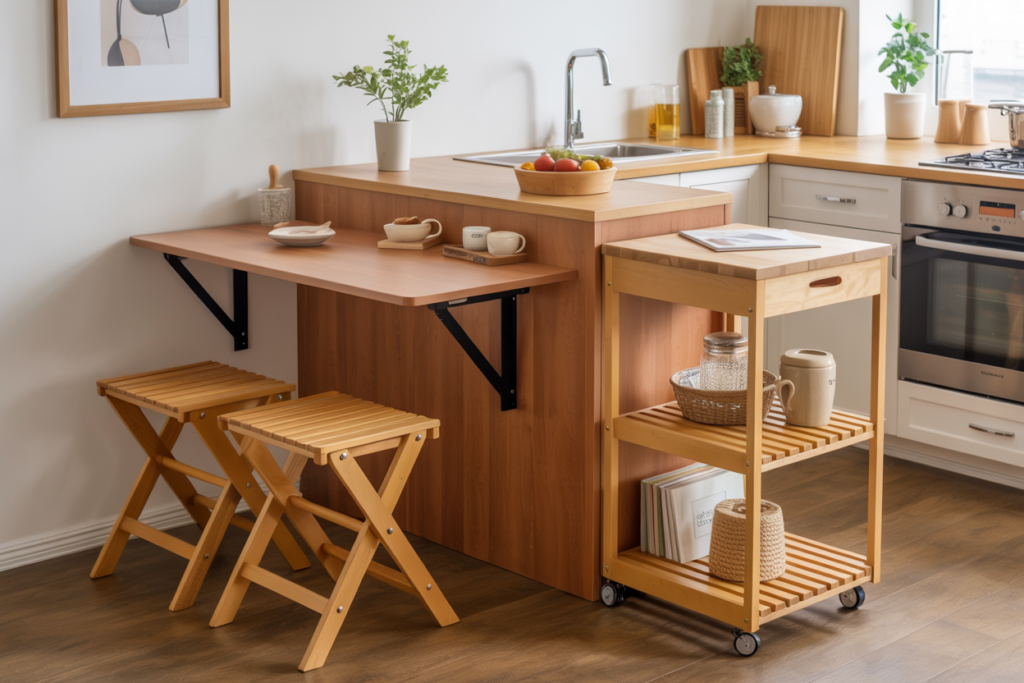
Use kitchen carts on wheels for movable storage and workspace. Roll carts where you need them during cooking, then tuck them away when not in use. The top provides extra prep surface while shelves below offer storage.
Choose carts with butcher block tops for additional cutting surfaces, or metal tops for durability. Some carts include wine racks, towel bars, or knife slots for added functionality.
Fold-Down Tables
Install wall-mounted fold-down tables that create dining or prep surfaces when needed and disappear when not. These provide full-size utility without permanently consuming floor space.
Mount fold-down tables at bar height for casual dining or lower for additional counter space. Ensure sturdy mounting for stability during use.
Stools with Storage
Choose counter stools with built-in storage—lift seats reveal hidden compartments perfect for linens, cookbooks, or serving pieces. This transforms seating into functional storage without additional footprint.
Select stools that tuck completely under counters when not in use to maintain walking space.
Convertible Surfaces
Use cutting boards that fit over sinks to create temporary counter space. When you need more prep area, the board covers the sink. Afterward, it stores vertically in a cabinet or hangs on the wall.
Similarly, use stove covers that create counter space over burners when not cooking. These clever solutions temporarily expand workspace precisely when you need it.
Shop Multifunctional Kitchen Furniture
IKEA RÅSKOG Cart $30 – $50
Affordable, mobile, slim profile fits tight spaces.
Catskill Craftsmen Kitchen Cart $150 – $250
Butcher block top, solid construction, provides extra prep surface.
CB2 Flip Small White Dining Table $199 – $299
Wall-mounted fold-down, seats 2-4, disappears when not needed.
West Elm Industrial Stool with Storage $149 – $199
Hidden storage, counter height, sturdy metal construction.
Hidden Storage Maximization
Utilize overlooked spaces for storage that doesn’t add visual clutter.
Inside Cabinet Doors
Mount small racks, hooks, or pockets on cabinet interior doors. Store lids, measuring cups, cutting boards, cleaning supplies, or spices. This previously-wasted space becomes valuable storage.
Over-the-door organizers designed for bathrooms work equally well in kitchens for storing lightweight items.
Toe-Kick Drawers
The space beneath base cabinets (toe-kick area) can house ultra-slim drawers perfect for flat items like baking sheets, cutting boards, serving platters, or place mats.
These require professional installation or carpentry skills but provide substantial hidden storage in otherwise-wasted space.
Corner Solutions
Corner cabinets notoriously waste space. Install lazy Susans, pull-out corner drawers, or specialized corner organizers that make deep corners accessible and functional.
For corner counters, use tiered stands or corner shelving units that maximize vertical space while keeping items visible and reachable.
Under-Shelf Baskets
Hang baskets or racks under existing shelves to double storage capacity. These work in cabinets, pantries, or on open shelving. Store lightweight items like dish towels, napkins, or snacks.
Ceiling-Mounted Racks
Install pot racks or hanging baskets from ceilings. This stores bulky cookware overhead, freeing cabinet space for items that don’t hang well. Ensure adequate head clearance—minimum 6.5 feet for safety.
Lighting for Function and Spaciousness
Proper lighting makes small kitchens feel larger while improving functionality.
Under-Cabinet Lighting
Install LED strips or puck lights under upper cabinets. This illuminates counters for food prep while eliminating shadows that make small spaces feel cramped. Under-cabinet lighting also creates ambiance and visual interest.
Choose warm white bulbs (2700K-3000K) for inviting atmosphere rather than cool white that feels institutional.
Pendant Lights for Task and Style
Hang pendant lights over islands, peninsulas, or dining areas. These provide focused task lighting while adding decorative elements. Choose styles that complement your aesthetic—glass globes for modern, woven materials for boho, metal for industrial.
Keep pendants proportional to space—small kitchens need smaller fixtures that don’t overwhelm.
Maximize Natural Light
Keep window treatments minimal. Sheer curtains, bamboo shades, or café curtains provide privacy without blocking natural light. Remove heavy drapes that darken spaces.
If privacy isn’t a concern, leave windows bare entirely. Natural light makes spaces feel exponentially larger and more inviting.
Strategic Mirror Placement
Mount mirrors on walls opposite windows to reflect natural light throughout the space. Mirrored backsplashes dramatically expand visual space while reflecting light. Even small mirrored accents contribute to brightness and openness.
Shop Lighting & Organization Solutions
Philips LED Under Cabinet Lighting $25 – $50
Energy efficient, easy installation, bright task lighting.
West Elm Glass Globe Pendant $79 – $129
Modern design, provides good light, appropriate scale for small kitchens.
Rev-A-Shelf Corner Cabinet Organizer $80 – $150
Maximizes corner space, pull-out design, professional-looking solution.
SimpleHouseware Stackable Can Organizer $18 – $28
Maximizes cabinet depth, keeps cans visible, budget-friendly.
Decluttering for Function and Style
Small kitchens can’t accommodate unnecessary items. Ruthless decluttering creates both function and improved aesthetics.
The One-In-One-Out Rule
When acquiring new kitchen items, remove something existing. This prevents accumulation and forces evaluation of what truly deserves limited space.
Edit Ruthlessly
Remove duplicate items. Do you really need four spatulas, three can openers, or six mugs? Keep favorites, donate duplicates.
Eliminate single-purpose gadgets used rarely. Specialized tools that perform one function and sit unused for months waste precious space.
Visible Storage Only for Beautiful or Useful
If items aren’t actively beautiful or frequently used, they shouldn’t occupy visible storage. Store occasional-use items in harder-to-reach cabinets.
Everyday items deserve prime real estate—easy access and visible storage. Store them where you naturally reach.
Seasonal Rotation
Store seasonal items (holiday baking supplies, picnic ware, seasonal appliances) outside the kitchen when not in season. Use basement, garage, or closet storage for items used only few months yearly.
Digital Decluttering
Photograph recipe cards and cookbook pages you actually use, then donate the physical books. Store recipes digitally to free shelf space while maintaining access.
Smart Appliance Storage
Small appliances consume significant counter and cabinet space. Strategic storage keeps kitchens functional without clutter.
Appliance Garages
Create “appliance garages”—dedicated cabinet sections with roll-up doors or hinged panels that hide appliances while keeping them accessible. Coffee makers, toasters, and blenders stay plugged in but disappear behind doors.
Vertical Appliance Storage
Store appliances vertically in cabinets using shelf risers or specialized organizers. This utilizes full cabinet height rather than wasting vertical space above short appliances.
Appliance Lifts
Install heavy-duty shelves that lift mixer or food processors from base cabinets to counter height. These mechanisms hide heavy appliances when not needed but raise them for easy access during use.
Keep Counters Clear
Store all but 1-2 most-used appliances. Coffee makers or electric kettles used daily can stay out. Everything else should have assigned cabinet homes to maintain clear workspace.
Visual Tricks for Perceived Space
Design choices trick the eye into perceiving more space than actually exists.
Clear or Glass Elements
Use glass cabinet doors, clear storage containers, transparent bar stools, or glass tables. These “see-through” elements reduce visual weight and create airiness.
Vertical Lines
Incorporate vertical elements—vertical tile patterns, floor-to-ceiling cabinets, vertical paneling. Vertical lines draw eyes upward, making ceilings feel higher.
Minimal Upper Cabinets
Replace some upper cabinets with open shelving or eliminate entirely. This prevents the closed-in feeling solid cabinets create while maintaining storage through thoughtful shelving.
Consistent Flooring
Extend the same flooring from adjacent rooms into the kitchen. Continuous flooring eliminates visual breaks that make spaces feel chopped up and smaller.
Simple Hardware
Choose minimal cabinet hardware—simple pulls or knobs in cohesive finishes. Oversized or ornate hardware visually clutters small spaces.
Budget-Friendly Small Kitchen Hacks
Maximizing small kitchens doesn’t require expensive renovations. Many effective hacks cost minimal money.
Paint Transformation: Fresh paint in light, cohesive colors dramatically impacts spaciousness. Paint cabinets, walls, and trim for complete transformation at modest cost.
Peel-and-Stick Updates: Use removable wallpaper or tile decals for backsplash updates. These renter-friendly options add style without permanent changes or high costs.
DIY Shelving: Build simple floating shelves from lumber and brackets. Basic shelving provides substantial storage for fraction of custom cabinet costs.
Tension Rods: Use tension rods inside cabinets to create vertical dividers for baking sheets, cutting boards, or lids. This simple solution organizes awkward items cheaply.
Command Hooks: Mount adhesive hooks inside cabinets or on walls for hanging lightweight items. Remove without damage when moving or changing organization.
Repurpose Furniture: Small dressers, bar carts, or bookshelves from other rooms provide kitchen storage at no additional cost.
Maintaining Small Kitchen Organization
Creating organization is one thing; maintaining it requires ongoing habits.
Daily Reset: Spend 10 minutes nightly returning items to designated homes, clearing counters, and loading/unloading dishwasher. This prevents overwhelming accumulation.
Weekly Purge: Once weekly, remove items that migrated to kitchen but don’t belong. Return mail, keys, bags, and non-kitchen items to proper homes.
Monthly Evaluation: Monthly, reassess organization systems. Are current solutions working? Do adjustments improve function? Make small tweaks regularly rather than waiting for complete breakdown.
Seasonal Deep Clean: Quarterly, deep clean and reorganize thoroughly—purge expired items, reorganize cabinets, clean under and behind appliances.
Maintenance prevents small kitchens from degrading into cluttered chaos that undermines both function and style.
Common Small Kitchen Mistakes
Over-Decorating: Small kitchens can’t handle excessive decor. Choose few meaningful pieces rather than cluttering surfaces with knickknacks.
Dark Colors: While possible to use successfully, dark colors generally make small spaces feel smaller. Light, reflective colors expand visually.
Bulky Furniture: Oversized tables, chunky carts, or massive storage pieces overwhelm small kitchens. Choose appropriately-scaled furniture.
Closed Storage Only: All closed cabinets create cave-like feelings. Mix open and closed storage for visual lightness.
Ignoring Vertical Space: Focusing only on horizontal surfaces wastes valuable vertical storage potential.
Keeping Everything: Small kitchens demand selectivity. Keeping items “just in case” creates clutter that undermines function.
Conclusion: Your Maximized Small Kitchen
Transforming small kitchens from cramped and cluttered to stylish and functional doesn’t require major renovations or unlimited budgets. It requires strategic thinking: utilizing vertical spaces, choosing multifunctional pieces, implementing clever storage, and making intentional design choices that create visual spaciousness.
Start with the hacks addressing your biggest frustrations. Struggling with counter space? Add fold-down surfaces or cart storage. Drowning in clutter? Install vertical storage and declutter ruthlessly. Feeling cramped? Implement light colors and reflective surfaces.
Remember that small kitchens are opportunities for creativity, not limitations to resent. Every thoughtfully-chosen solution makes your space work harder and look better. Every clever hack proves that square footage matters less than smart design.
Your small kitchen can be both highly functional and genuinely beautiful. These decor hacks provide tools for achieving both, transforming limitations into design features and creating spaces that work beautifully for your real life. Whether you’re cooking elaborate meals, entertaining friends, or simply making morning coffee, your maximized small kitchen supports and enhances every kitchen moment.
The goal isn’t perfection—it’s creating a kitchen that serves your needs efficiently while surrounding you with intentional beauty. That’s achievable in any size kitchen when you approach challenges strategically and embrace creative solutions that maximize both style and functionality.