

Small Space Scandinavian Interior Hacks for Apartments & Tiny Homes
Turn cramped corners into calming, functional spaces with minimalist Scandinavian floating shelves. Perfect for tiny homes, rentals, or small apartments wanting a lighter, cleaner look.
HOME DECOR
FONNI
12/31/202514 min read
The content on this site was created with the help of AI. LOVEOWE LLC participates in the Amazon Services LLC Associates Program and other affiliate programs. As an Amazon Associate, I earn from qualifying purchases. This means I may earn a small commission—at no extra cost to you—when you make a purchase through links on this site. All opinions are my own. Learn more click here. Thank you for your support!
Living in a small space doesn't mean sacrificing style or that coveted sense of calm that makes Scandinavian interiors so appealing. In fact, Nordic design principles were practically made for compact living—the entire aesthetic centers on functionality, simplicity, and making the most of natural light, which are exactly the challenges you face in apartments and tiny homes. There's a reason why Scandinavian countries, where long, dark winters and urban apartments are the norm, have perfected the art of creating spaces that feel open, breathable, and inviting despite limited square footage. The magic lies not in expensive renovations or knocking down walls, but in thoughtful choices about color, furniture scale, storage solutions, and how you use every single inch of your space intentionally.
What makes Scandinavian design particularly brilliant for small spaces is its emphasis on "lagom"—the Swedish concept of "just right" or "not too much, not too little." This philosophy translates into interiors that are carefully edited rather than cluttered, where every piece serves a purpose and contributes to the overall sense of serenity. We're talking about spaces that breathe despite their compact footprints, where white walls aren't boring but rather serve as a canvas for texture and light, and where clever storage solutions disguise themselves as beautiful design elements. Whether you're working with a studio apartment, a one-bedroom in the city, or a tiny home that requires serious spatial strategy, these Scandinavian-inspired hacks will help you create a space that feels twice its actual size while maintaining that effortlessly chic Nordic aesthetic that makes you want to curl up with a good book and a cup of coffee.
Master the Scandinavian Color Palette for Visual Expansion
Color is your most powerful tool for making small spaces feel larger, and Scandinavian interiors have this down to a science. The right palette creates the illusion of expanded space while maintaining that warm, inviting atmosphere that prevents your home from feeling cold or sterile.
Essential Color Strategy Elements:
White walls as your foundation: Pure white, warm white, or soft off-white creates a bright backdrop that reflects light and makes boundaries feel less defined
Neutral base layers: Incorporate soft greys, warm beiges, and natural wood tones that add depth without visual weight
Muted accent colors: Introduce subtle blues, sage greens, dusty pinks, or terracotta in small doses through textiles and accessories
Black or dark accents: Strategic use of black in window frames, light fixtures, or small furniture pieces adds definition and sophistication
Key Features of Effective Small-Space Color:
Continuity across rooms or zones—using the same white throughout eliminates visual breaks that make spaces feel chopped up
Layering different shades within the same color family to create depth without introducing jarring contrasts
Light-reflective finishes on walls and ceilings that bounce natural light around the space
Color introduced through easily changeable elements like throw pillows, blankets, and art rather than large permanent pieces
Avoiding stark contrast between walls and trim which can make rooms feel smaller by highlighting their boundaries
Implementation Ideas for Different Spaces:
Paint everything—walls, ceiling, and trim—in the same soft white to create seamless visual flow that tricks the eye into seeing more space
Use varying tones of grey from light to charcoal to create zones without actual walls in studio apartments
Introduce warmth through natural wood furniture in light oak, ash, or birch rather than relying on wall color
Add personality with textiles in muted accent colors that you can easily swap out seasonally
Tips and Considerations:
Test paint colors in your actual space at different times of day since lighting drastically affects how white reads
Don't fear white walls in small spaces—they're your secret weapon for making rooms feel airy and open
Consider the undertones in your whites; cool whites work in spaces with lots of natural light while warm whites prevent north-facing rooms from feeling cold
Remember that Scandinavian color palettes feel cohesive rather than matchy-matchy—slight variations are intentional and beautiful
Shop Color & Paint Essentials
Product Price Range Why It's Worth It Where to Shop Premium White Paint in Warm Undertone (1 gallon) $45-$70 Low-VOC formula, excellent coverage, warm white perfect for small spaces, durable finish [Add Link] Sample Paint Set - Nordic Neutrals $25-$35 Test multiple shades before committing, includes warm whites and soft greys, helps you find your perfect tone [Add Link] Matte Black Spray Paint for Fixtures $8-$12 Updates hardware and fixtures instantly, professional matte finish, transforms spaces affordably [Add Link] Quality Paint Brushes & Roller Set $20-$35 Smooth application without streaks, durable for future touch-ups, professional-looking results [Add Link]
Maximize Light: The Scandinavian Secret to Spaciousness
Scandinavian interiors are obsessed with light—both natural and artificial—because it's the most effective way to make small spaces feel open and welcoming. During those long Nordic winters, maximizing every bit of available light becomes essential, and these principles work beautifully in compact homes.
Natural Light Maximization Strategies:
Minimal window treatments: Skip heavy curtains in favor of sheer linen panels or leave windows completely bare if privacy allows
Strategic mirror placement: Position mirrors opposite or adjacent to windows to bounce light deeper into rooms
Light-reflective surfaces: Choose furniture with light wood finishes, glass tops, or glossy surfaces that reflect rather than absorb light
Clear pathways to windows: Keep furniture low and away from windows to allow light to travel unobstructed into the space
Artificial Lighting Layers:
Ambient lighting: Ceiling fixtures or pendant lights that provide overall illumination without harsh shadows
Task lighting: Reading lamps, desk lights, or under-cabinet lighting for specific activities
Accent lighting: Wall sconces, LED strips, or candles that create warmth and dimension
Multiple light sources: Three or more light sources per room creates that layered, cozy Scandinavian glow
Implementation Ideas for Better Lighting:
Hang large mirrors on walls perpendicular to windows to reflect views and light back into the room
Replace heavy curtain rods with simple tension rods and lightweight linen panels that filter light without blocking it
Install dimmer switches on all main lights to control ambiance and energy throughout the day
Use warm white LED bulbs (2700-3000K) to mimic natural daylight while keeping spaces feeling cozy
Tips and Considerations:
Avoid overhead lighting alone—it creates harsh shadows and makes spaces feel less inviting
Consider the color temperature of your bulbs; warm whites feel more Scandinavian than cool whites
Keep window sills clear of clutter to maximize the light that enters your space
Remember that in small spaces, lighting affects perceived size more than almost any other element
Shop Lighting Solutions
Product Price Range Why It's Worth It Where to Shop Large Round Wall Mirror (24-30") $60-$110 Maximizes light reflection, frameless or thin brass frame, hangs easily, visual impact [Add Link] Linen Curtain Panels in Natural White $35-$60 per panel Filters light beautifully, breathable fabric, simple tab-top or rod pocket, washable [Add Link] Adjustable LED Floor Lamp $75-$130 Scandinavian design, adjustable height and direction, warm white LED, minimal footprint [Add Link] Pendant Light in Matte Black $55-$95 Statement piece, focuses light downward over tables, modern Nordic aesthetic [Add Link] Warm White LED Bulb Set (6-pack) $15-$25 Energy efficient, 2700K color temperature, long-lasting, perfect Scandinavian glow [Add Link] Taper Candle Holders in Brass $20-$40 Adds warmth and ambiance, minimal design, multiple heights create dimension [Add Link]
Smart Furniture Choices That Work Overtime
In small Scandinavian-inspired spaces, furniture needs to be both beautiful and extraordinarily functional. Every piece should earn its place through either multi-functionality, appropriate scale, or by contributing to the overall sense of openness.
Essential Furniture Principles:
Multi-functional pieces: Beds with storage drawers, ottomans that open for hidden storage, coffee tables with lift tops or shelving
Scaled appropriately: Furniture sized for your actual space rather than aspirational larger homes—a loveseat often works better than a full sofa
Raised on legs: Furniture elevated on visible legs creates visual lightness and makes spaces feel larger than heavy, grounded pieces
Light wood tones: Oak, ash, birch, or beech in natural or light finishes that don't visually weigh down the room
Key Features to Look For:
Clean-lined silhouettes without excessive ornamentation that would create visual clutter
Modular or moveable pieces that can be rearranged as your needs change
Built-in storage that disguises itself rather than looking like obvious organizational solutions
Furniture that serves multiple purposes—dining tables that function as desks, benches with hidden storage
Proportions that leave negative space around them rather than filling every inch
Implementation Ideas by Room:
Choose a platform bed with built-in drawers instead of a traditional bed frame plus separate dresser
Opt for a console table behind a sofa that serves as both workspace and display area
Use a bench with storage as both seating and a place to stash shoes, blankets, or seasonal items
Select nesting tables that can be pulled out when needed and tucked away when not in use
Tips and Considerations:
Measure your space carefully before buying furniture—too large is worse than slightly too small
Leave at least 18-24 inches of walking space around furniture for proper flow
Consider furniture that can be easily moved or reconfigured as your needs evolve
Invest in quality pieces for items you use daily while saving on purely decorative elements
Shop Smart Furniture
Product Price Range Why It's Worth It Where to Shop Platform Storage Bed in Light Oak $350-$600 Four large drawers underneath, clean Scandinavian lines, light wood finish, sturdy construction [Add Link] Modular Sofa in Light Grey $550-$900 Configurable sections, raised wooden legs, neutral upholstery, perfect scale for small spaces [Add Link] Extendable Dining Table in Birch $280-$450 Seats 2-6 people, compact when closed, light wood tone, multifunctional as workspace [Add Link] Storage Ottoman in Natural Linen $120-$200 Hidden storage inside, doubles as extra seating or coffee table, soft neutral fabric [Add Link] Open Shelving Unit in White/Oak $150-$280 Visible legs create airiness, mix of closed and open storage, Scandinavian aesthetic [Add Link] Nesting Side Tables Set of 2 $80-$140 Light wood tops with black metal frames, tuck away when not needed, versatile placement [Add Link]
Vertical Storage: Your Best Friend in Small Spaces
When you're short on floor space, the only direction to go is up. Scandinavian design embraces vertical storage solutions that are both highly functional and aesthetically pleasing, turning necessary storage into design features.
Vertical Storage Strategies:
Floor-to-ceiling shelving: Open shelving or closed cabinets that maximize wall height and draw the eye upward
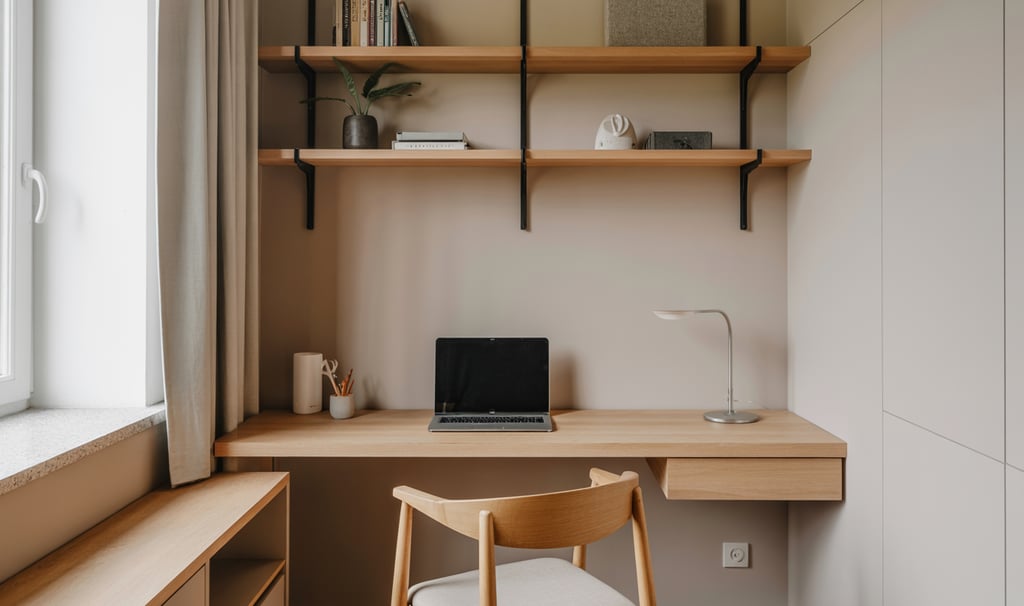
Wall-mounted solutions: Floating shelves, pegboards, or modular wall systems that keep floors clear
High-mounted hooks and rails: Coat hooks, towel bars, or hanging rails installed near the ceiling for items used less frequently
Tall narrow cabinets: Slim storage towers that fit in tight spaces while providing substantial storage capacity
Key Features of Effective Vertical Storage:
Installation that's secure and weight-appropriate for what you're storing
Mix of open and closed storage to balance display with hidden organization
Consistent styling across vertical elements to maintain visual calm
Strategic placement that doesn't block light or make ceilings feel lower
Accessibility considerations—daily-use items within reach, occasional items higher up
Implementation Ideas for Different Areas:
Install floating shelves in the kitchen for dishes, glasses, and decorative items that would otherwise take up cabinet space
Use a tall bookshelf room divider to separate zones in a studio while providing double-sided storage
Mount a pegboard in the entryway for coats, bags, and keys that keeps floors clear
Add shelving above doorways for seasonal items or books you don't access regularly
Tips and Considerations:
Paint shelving and storage the same color as walls to make them recede visually
Style open shelving thoughtfully—too cluttered defeats the purpose, but too sparse looks empty
Use uniform storage boxes or baskets on shelves to create visual cohesion
Consider weight limits carefully and use proper anchors in your wall type
Shop Vertical Storage Solutions
Product Price Range Why It's Worth It Where to Shop Floating Shelf Set (3 shelves) in White $40-$70 Clean look, includes mounting hardware, various lengths, invisible brackets [Add Link] Floor-to-Ceiling Bookshelf in Light Wood $200-$350 Maximizes vertical space, adjustable shelves, Scandinavian design, room divider option [Add Link] Wall-Mounted Coat Rack with 5 Hooks $25-$45 Keeps entryways organized, wooden or brass hooks, minimal design, easy installation [Add Link] Modular Pegboard System $35-$60 Customizable configuration, includes hooks and shelves, functional art piece, rearranges easily [Add Link] Narrow Storage Cabinet in White $120-$200 Slim profile for tight spaces, multiple shelves, enclosed storage, perfect for bathrooms or kitchens [Add Link] Over-Door Storage Rack $20-$35 Maximizes unused door space, holds shoes, accessories, or pantry items, no installation required [Add Link]
Textile Layering: Adding Warmth Without Clutter
Scandinavian interiors achieve their signature cozy-yet-minimal aesthetic through thoughtful layering of textiles. In small spaces, this becomes even more important because textiles add softness and warmth without taking up precious square footage.
Essential Textile Categories:
Natural fiber rugs: Jute, wool, or cotton rugs that define spaces and add texture underfoot without overwhelming small rooms
Linen and cotton textiles: Curtains, throw pillows, and blankets in breathable natural fabrics that feel luxurious but relaxed
Layering pieces: Multiple smaller textiles layered together create depth more effectively than one large statement piece
Neutral color stories: Whites, greys, beiges, and natural tones that coordinate effortlessly
Key Features for Small-Space Textiles:
Lightweight fabrics that drape beautifully without creating bulk
Machine-washable materials for practical everyday living
Neutral bases with subtle texture through weave or material rather than busy patterns
Appropriate scale—smaller pillows and throws in tiny spaces, larger in slightly bigger rooms
Natural materials that align with Scandinavian principles and age beautifully
Implementation Ideas for Cozy Layers:
Layer a sheepskin or faux fur throw over a simple sofa to add texture and warmth
Use linen throw pillows in varying sizes and subtle tones to create dimension on beds and seating
Place a natural fiber rug under key furniture groupings to define zones in open-plan spaces
Drape a chunky knit blanket over a ladder or blanket rack as both storage and decoration
Tips and Considerations:
Stick to a limited color palette across all textiles for visual cohesion
Choose quality over quantity—fewer beautiful textiles beats lots of mediocre ones
Consider seasonal swaps with lighter textiles in spring/summer and heavier in fall/winter
Don't forget texture on walls—a woven wall hanging adds interest without floor space
Shop Scandinavian Textiles
Product Price Range Why It's Worth It Where to Shop Natural Jute Rug (5x7 or 6x9) $80-$150 Durable natural fiber, neutral tone grounds spaces, flatweave doesn't add bulk [Add Link] Linen Throw Pillow Covers Set of 2 $25-$45 Removable for washing, soft washed linen, neutral colors, European quality [Add Link] Chunky Knit Throw Blanket in Cream $55-$95 Oversized texture adds warmth, machine washable, cozy Scandinavian essential [Add Link] Cotton Waffle Weave Blanket $40-$70 Lightweight but warm, beautiful texture, breathable, perfect year-round layer [Add Link] Sheepskin or Faux Fur Throw $45-$80 Instant coziness, drapes over furniture, natural or faux options, softens hard surfaces [Add Link] Linen Curtain Panels - Set of 2 $50-$90 Natural light filtering, breathable fabric, rod pocket or tab top, soft drape [Add Link]
Strategic Decluttering: The Foundation of Scandinavian Style
You cannot Scandinavian-ize a cluttered space. The entire aesthetic rests on the principle of intentional curation where every visible item has purpose and beauty. In small spaces, decluttering isn't just aesthetic—it's functional survival.
Decluttering Principles:
One in, one out rule: When you bring something new into your space, something old leaves
Visible surfaces mostly clear: Counters, tables, and shelves should be at least 70% empty to maintain that breathing room
Hidden storage for daily chaos: Everything from mail to chargers needs a designated hidden home
Regular editing sessions: Quarterly reviews of what you own and whether it still serves your life
Implementation Strategies:
Create "homes" for categories of items—all tech accessories in one drawer, all kitchen tools in one area
Use drawer dividers and small organizers inside closed storage to maximize space and maintain order
Designate a landing zone near your entrance for keys, mail, and daily essentials
Adopt a capsule approach to kitchen items, keeping only what you regularly use and storing or donating the rest
What to Keep Visible in Small Spaces:
Beautiful functional items like a teapot, cutting boards, or ceramics that serve as decor
Books arranged thoughtfully on shelves with breathing room between them
A few carefully chosen decorative objects with meaning or aesthetic value
Plants that add life and color without creating visual clutter
Tips and Considerations:
Be ruthless about duplicates—you don't need three spatulas or five coffee mugs per person
Digitize papers, manuals, and photos wherever possible to eliminate paper clutter
Use the "do I love it or need it" test for items that are borderline
Remember that empty space is a design element in Scandinavian interiors, not something to fill
Shop Organizational Essentials
| Product | Price Range | Why It's Worth It | Where to Shop | |---------|-------------|-------------------||||||||| | Drawer Organizer Set | $18-$30 | Keeps drawers functional, bamboo or acrylic options, expandable sizes, prevents junk accumulation | [Add Link] | | Storage Baskets in Natural Weave | $25-$50 per set | Hides clutter beautifully, natural materials, various sizes nest together, fits Scandinavian aesthetic | [Add Link] | | Wall-Mounted Mail Organizer | $20-$40 | Keeps paperwork corralled, minimal design, multiple compartments, prevents counter clutter | [Add Link] | | Under-Bed Storage Boxes with Wheels | $30-$55 | Utilizes wasted space, wheels for easy access, enclosed to keep items dust-free | [Add Link] | | Cable Management Box | $15-$25 | Hides charging cables and power strips, clean aesthetic, prevents tech clutter | [Add Link] |
Bringing Nature Indoors: The Scandinavian Life Essential
Plants and natural elements are non-negotiable in Scandinavian design—they bring life, color, and connection to nature into your space. In small homes, the right plants add vitality without overwhelming your square footage.
Plant Selection for Small Spaces:
Vertical growers: Snake plants, pothos, or philodendrons that grow upward or trail rather than spreading wide
Multi-level plant stands: Tiered stands that display multiple plants in the footprint of one
Hanging plants: Utilize ceiling space with trailing plants in macramé hangers or simple hooks
Small but mighty: Succulents, small ferns, or herbs on windowsills that add green without taking up floor space
Natural Elements Beyond Plants:
Wood accents: Cutting boards, bowls, or decorative branches that bring organic warmth
Stone and ceramics: Natural materials in vessels, planters, or decorative objects
Dried flowers and grasses: Low-maintenance botanicals in simple vases
Natural light wood furniture: Oak, ash, or birch that connects to nature
Implementation Ideas:
Create a plant corner with a tall floor plant flanked by smaller plants on a side table or stool
Hang plants in windows to maximize light without blocking it or taking floor space
Use floating shelves as plant ledges in kitchens or bathrooms where counter space is limited
Group plants in odd numbers (3 or 5) at varying heights for visual interest
Tips and Considerations:
Start with low-maintenance plants like pothos, snake plants, or ZZ plants if you're not confident
Consider light requirements—not all spaces can support high-light plants
Use cachepots to hide plastic nursery pots while maintaining drainage
Don't overcrowd—a few healthy plants beat many struggling ones
Shop Natural Elements
Product Price Range Why It's Worth It Where to Shop Modern Plant Stand in Natural Wood $35-$60 Elevates plants, minimal Scandinavian design, various heights available, stable construction [Add Link] Ceramic Planter Set of 3 $25-$45 Drainage holes, minimalist design, neutral colors, multiple sizes for different plants [Add Link] Macramé Plant Hanger $15-$28 Utilizes vertical space, adjustable height, natural cotton, holds various pot sizes [Add Link] Low-Maintenance Plant Bundle $40-$75 Includes 3-5 easy-care plants, perfect for beginners, various sizes, ships healthy [Add Link] Wooden Tray or Bowl $20-$40 Natural wood grain, functional and decorative, corrals small items, organic warmth [Add Link] Glass Vase in Simple Shape $12-$25 Displays fresh or dried botanicals, clear glass doesn't add visual weight, versatile size [Add Link]
Creating Zones in Open-Plan Small Spaces
When you're working with a studio or open-concept small apartment, creating distinct zones without walls is essential for functionality and maintaining that Scandinavian sense of order and purpose.
Zoning Strategies Without Walls:
Furniture placement: Position sofas or bookcases perpendicular to walls to suggest boundaries between spaces
Rug definition: Use area rugs to visually define living, sleeping, and dining zones
Lighting changes: Different lighting types in different zones signals their purpose—pendant over dining, floor lamp by sofa
Color or material shifts: Subtle changes in wall color, flooring, or materials can delineate areas
Key Features of Successful Zoning:
Maintains visual flow and doesn't make the space feel choppy or closed in
Allows light to travel through the space unobstructed
Creates psychological separation for different activities without physical barriers
Uses furniture as functional dividers that serve dual purposes
Implementation Ideas:
Place a sofa facing away from the bedroom area to create a psychological barrier
Use a bookshelf as a room divider that provides storage on both sides
Hang a sheer curtain or linen panel that can be drawn for privacy but doesn't block light when open
Position a narrow console table behind a sofa to separate living and sleeping zones
Tips and Considerations:
Keep dividing elements low enough to maintain sight lines across the space
Use consistent color throughout zones to maintain cohesion
Consider traffic flow when placing furniture dividers—maintain clear pathways
Don't over-zone a small space; sometimes 2-3 clear zones are better than trying to create five
Creating Your Small-Space Scandinavian Sanctuary
Transforming a small apartment or tiny home into a Scandinavian-inspired haven isn't about following a strict set of rules or buying every piece of furniture from a specific store—it's about embracing the underlying principles that make Nordic design so livable and beautiful. The magic happens when you prioritize light, choose quality over quantity, embrace negative space as a design element, and remember that every single item in your home should either serve a function or bring you genuine joy. Small spaces, when approached with Scandinavian sensibility, don't feel limiting—they feel intentional, curated, and surprisingly spacious.
What makes this approach so sustainable is that it works with human nature rather than against it. You're not trying to cram more stuff into less space or create complicated organizational systems you'll abandon in a week. Instead, you're simplifying, editing, and choosing pieces that genuinely make your life better and your space more beautiful. As you implement these hacks—whether you start with paint, lighting, furniture, or decluttering—you'll notice your small space begins to breathe. That cramped feeling dissipates, replaced by a sense of calm and order that makes coming home feel like a reset button for your entire day. And isn't that exactly what our homes should be? Not showcases of how much we can fit into them, but carefully crafted sanctuaries that reflect who we are and support how we actually want to live, regardless of square footage.