Chronic Pain Kitchen Organization: How to Set Up a Beautiful, Functional Space When Standing Is the Hard Part
The content on this site was created with the help of AI. LOVEOWE LLC participates in the Amazon Services LLC Associates Program and other affiliate programs. As an Amazon Associate, I earn from qualifying purchases. This means I may earn a small commission—at no extra cost to you—when you make a purchase through links on this site. All opinions are my own. Learn more click here. Thank you for your support!
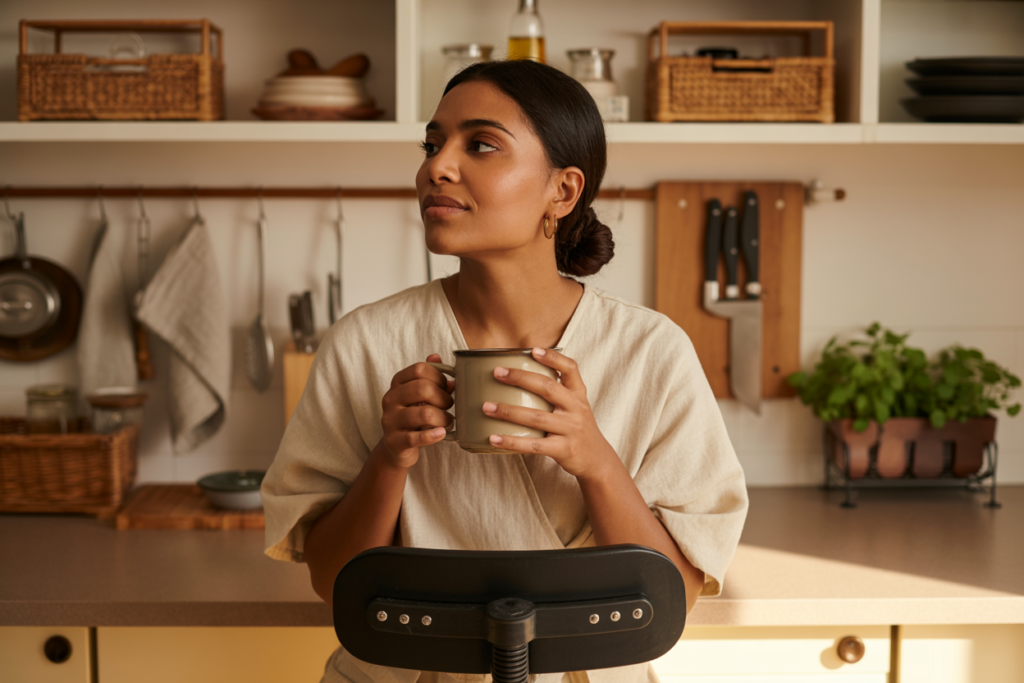
For a long time, I cooked standing up because that was how cooking worked. You stood at the counter, you stood at the stove, you stood at the sink. You moved between those three points and you managed. And then came the season where managing meant something different — where standing for twelve minutes at the stove cost me the rest of the afternoon, where reaching into a low cabinet sent pain through my back that didn’t resolve until the next morning, where I burned things not because I forgot about them but because getting back to the stove required a calculation I didn’t always have the energy to make.
The kitchen, I realized, had never been designed for me. It had been designed for an abstract person who could stand indefinitely, reach freely in all directions, grip things without consideration, and move between surfaces without cost. That person and I had less and less in common as my condition progressed, and the gap between what my kitchen assumed and what my body could actually do was becoming a daily source of pain, frustration, and a specific kind of grief that comes from losing ordinary things.
What I did not expect was that changing the kitchen would feel like getting something back.
Not everything — not the effortless version of cooking I used to take entirely for granted. But something real. The ability to make a meal without paying for it for two days after. The ability to move through my own kitchen without bracing. The ability to look at a space I spend real time in and see something that was designed with my actual body in mind, that reflects the same care and intention I try to bring to every other part of my healing life.
That is what this post is. It is not an accessibility guide in the clinical sense — not a checklist of ADA-compliant modifications or a medical equipment catalog. It is a LOVEOWE kitchen: functional, beautiful, and built around the truth of what chronic pain actually asks of a body in a kitchen. We are going to cover the specific changes that make the most meaningful difference — from how your kitchen is organized to what tools you use to how the space itself is set up — and sixteen products that do the work without sacrificing the look.
The Problem with Standard Kitchen Design for Chronic Pain
Standard kitchen design optimizes for one thing: efficiency for an able-bodied person standing at full height. Counters are set at a fixed height — typically 36 inches — calibrated for standing use. Storage is distributed vertically, with upper cabinets requiring reaching overhead and lower cabinets requiring bending toward the floor. The workflow assumes continuous movement between counter, stove, and sink with no need to rest between them. Everything is designed for someone who can stand at the counter for forty-five minutes and call it a normal dinner preparation.
For people with chronic pain, fibromyalgia, POTS, arthritis, EDS, lupus, back conditions, or any illness that affects stamina, joint stability, or the ability to sustain a standing position — this design is not neutral. It is actively working against you. Every overhead reach aggravates the shoulder, neck, and upper back. Every low cabinet bend loads the lumbar spine. Every minute of unsupported standing accumulates into a fatigue and pain cost that arrives somewhere between the onions and the pasta and makes finishing the meal a negotiation rather than a given.
The changes that make the most difference are not structural renovations. They are organizational, ergonomic, and tool-based — adjustments that can be made in any kitchen, in any home, including rentals, without a contractor or a significant budget. They are about bringing the things you use most within the range your body can comfortably reach, reducing the number of movements required to complete any given task, and adding the supports — physical and practical — that make sustained kitchen activity possible on days when it otherwise wouldn’t be.
The First Principle: Reorganize Around Your Body’s Actual Range
Before any product purchase, the single highest-impact change you can make to a chronic pain kitchen is a reorganization based on honest assessment of where your body can go without cost. Not where you can reach when you push through it — where you can reach comfortably, repeatedly, on a hard day.
For most people with chronic pain, that zone is a horizontal band roughly between hip and shoulder height. Everything below the hip requires a bend that loads the lower back. Everything above the shoulder requires a reach that loads the upper back, neck, and shoulders. The zone between those two points is your kitchen’s prime real estate, and it should contain everything you use every single day: your most-used cookware, your oils and most-used seasonings, your most-reached-for glasses and mugs, your cutting board, your knives.
Move everything that lives outside that zone according to frequency. Things you use weekly can live at the outer edges — lower cabinets with pull-out organization, upper shelves with a reacher tool. Things you use monthly can live wherever they fit. Things you use daily should never require you to bend to the floor or reach above your head. This single reorganization, which costs nothing, will change the daily experience of your kitchen more than any product on this list.
The Seating Edit: Because Standing Shouldn’t Be the Only Option in Your Own Kitchen
The most fundamental change in a chronic pain kitchen is also the one most people resist longest: introducing seating. Not because sitting to cook is a defeat — it is not — but because the idea of needing to sit in a space that has always been stood in carries a weight that is worth naming and then setting aside. You are allowed to sit in your kitchen. You are allowed to prep vegetables from a stool, to stir something on the stove from a seated position, to give your body the support it needs to keep cooking at all. These four make that possible without making your kitchen look like anything other than what it is: a beautiful, intentional space.

The foundation piece of a chronic pain kitchen. An adjustable-height stool with a back — not a backless bar stool, a stool with genuine lumbar support — positions your body at counter height with your back supported and your feet resting on a footrest rather than dangling, which matters for hip and lower back comfort during extended seated prep. Look for a swivel base so you can turn between counter and stove without twisting your spine, and a seat with enough cushioning to be comfortable for thirty to forty-five minutes of active use.

A rolling cart does two things simultaneously: it adds a moveable work surface at a height you choose, and it provides storage at exactly the level that works for your body. Position it at the stove so you have a surface to rest things on without turning or walking. Roll it to the counter when you need more prep space. Tuck it against a wall when you don’t need it. The wood or butcher block top reads as a design choice rather than an accommodation, and in most kitchens it looks like it was always there.
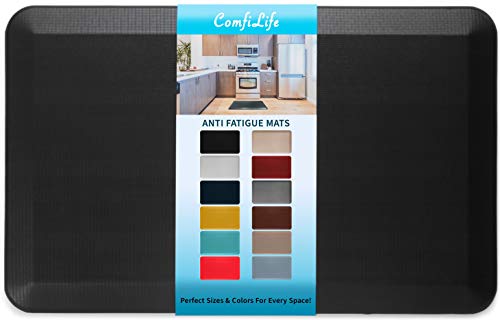
For the standing you still do. An anti-fatigue mat works by creating a slightly unstable surface that causes the small muscles in the feet and legs to make continuous micro-adjustments — which keeps blood circulating and reduces the static load that makes extended standing painful. The difference between standing on a hard floor and standing on a quality anti-fatigue mat is significant enough to be felt within the first five minutes. Position one at the stove, one at the sink — the two places where standing is least avoidable.
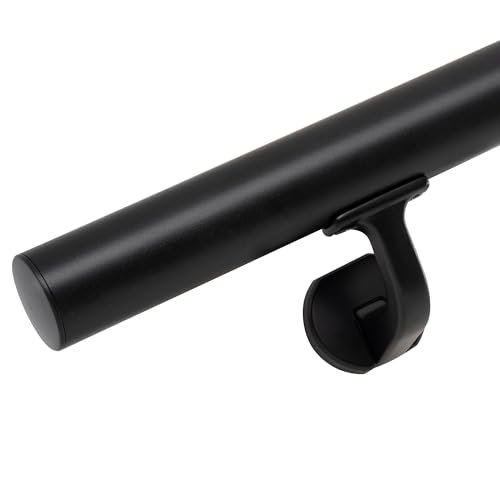
A discreet, wall-mounted support bar positioned at counter height gives you something to lean against during prep — offloading weight from your back and legs without requiring you to sit. In a matte black or brushed nickel finish, it reads as a design element: a rail for hanging towels, a architectural detail, something intentional rather than medical. Installed at the counter where you spend the most time standing, it changes the cost of that standing in a way that is hard to quantify until you have it.
The Second Principle: Reduce the Number of Movements Each Task Requires
Every unnecessary movement in the kitchen is a withdrawal from an energy account that chronic illness has already reduced. The goal of a chronic pain kitchen is not just to make individual movements easier — it is to reduce how many of them cooking requires in the first place.
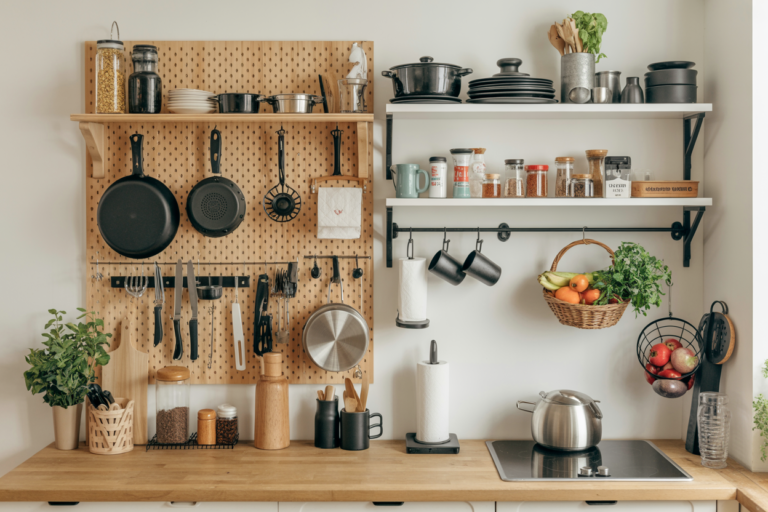
This is where kitchen organization becomes genuinely therapeutic. A lazy susan on a deep shelf means you rotate rather than dig. A pull-out drawer insert means you see everything at once rather than removing items one by one to find what’s behind them. A magnetic knife strip at counter height means your knives are reachable without opening a drawer. A countertop appliance that replaces a stovetop process means one less thing to monitor while standing.
Think through your most common cooking tasks and map how many individual movements they require. Then ask, for each one: is there a way to do this that requires fewer movements, less reaching, less time standing? The answer is usually yes, and the product category is usually small, affordable, and available without a renovation.
The Organization Edit: Less Reaching, Less Bending, Less of Everything That Costs You
These four address the organizational infrastructure of a chronic pain kitchen — the tools that bring what you need within range and reduce the movement required to access it.

The highest-return organizational purchase in a chronic pain kitchen. A lazy susan eliminates the need to remove items from a shelf or cabinet to reach what is behind them — you rotate the turntable instead, bringing everything forward without bending, reaching, or unloading. Use one in every deep cabinet, on every pantry shelf, inside the refrigerator for condiments and small jars. Stackable versions double the storage density without doubling the reach required to access it.

For lower cabinets where bending to the floor is the only way to access what’s stored at the back. A slide-out shelf installs inside an existing cabinet — no drilling, no tools in most versions — and converts a deep, low, hard-to-reach space into one where everything slides forward to meet you. Store your most-used pots and pans here, accessible without bending fully to the floor. A small change with an outsized effect on how much your lower back pays to cook dinner.
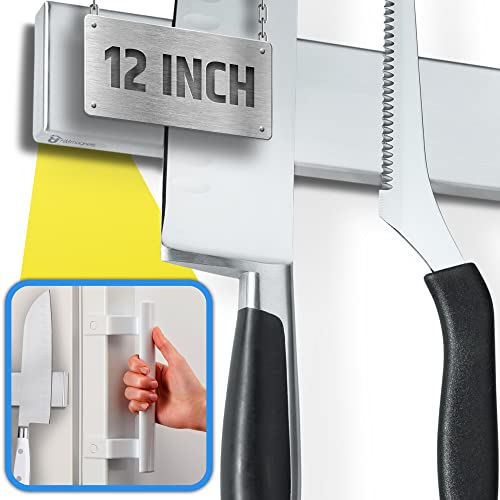
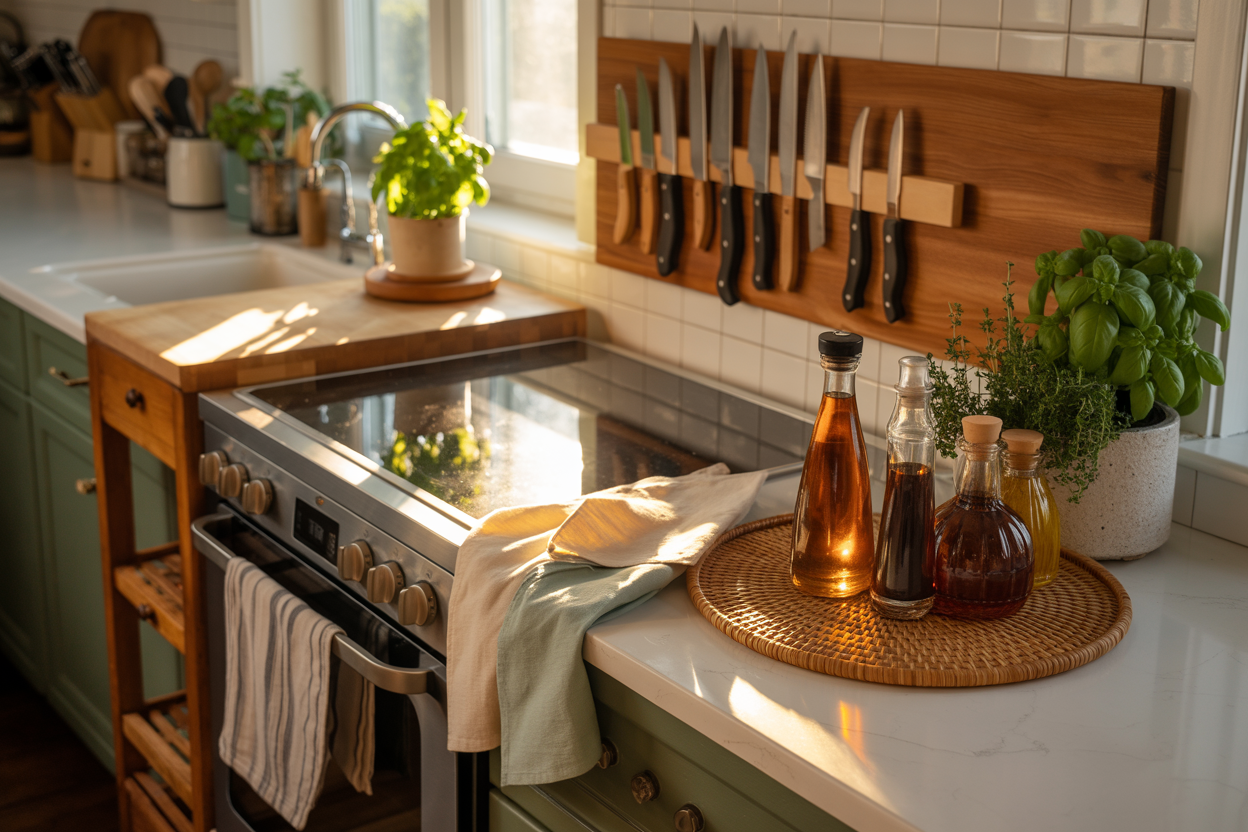
Knives stored in a block on the counter require a grip-and-pull motion that is deceptively demanding for people with hand pain, grip weakness, or joint instability. A magnetic strip mounted at counter height — or slightly above, at the backsplash — allows knives to be lifted off the surface with a single, low-grip motion rather than extracted from a slot. It also frees counter space, keeps knives visible so you reach for the right one immediately, and in a wood finish reads as a design feature that belongs in any well-appointed kitchen.

For the items that cannot be moved into prime real estate — the stock pot on the high shelf, the storage container at the back of the low cabinet. A reacher grabber with a rotating jaw extends your functional range without requiring your body to go where reaching hurts. Keep one in the kitchen, visibly accessible, without apology. In a chronic illness kitchen, a reacher is not a concession. It is the same category of tool as a knife or a spatula: a thing that makes the work possible.
The Third Principle: Replace Effort with Technology Wherever You Can
The conventional wisdom about cooking — that the effort is part of the point, that scratch cooking requires labor, that appliances are shortcuts for people who don’t care enough — was never built for people whose energy is a finite, carefully managed resource. For chronic illness, a slow cooker that requires five minutes of hands-on prep is not a shortcut. It is a strategy. A food processor that does in thirty seconds what would take six minutes of hand work is not laziness. It is energy management. An electric can opener is not a luxury. It is the difference between opening a can and not opening a can on a day when your hands have already done everything they can do.
The chronic pain kitchen uses technology deliberately and without guilt — specifically the technology that replaces the tasks most likely to be the breaking point. The chopping that strains the wrist. The stirring that requires standing at the stove. The opening, the peeling, the grinding that add up across a cooking session until the meal is finished but the person who cooked it isn’t.
Adapting your kitchen is self-advocacy in action. So is knowing how to ask for help.
If you’ve ever struggled to explain to someone — a doctor, a partner, a family member — exactly what cooking costs you and what you need in order to do it, Say This: 30 Scripts for Chronic Pain Communication has the language. Thirty ready-to-use scripts for the conversations that matter most, including the ones about what daily tasks actually require from a body managing chronic pain. Because asking for the right support starts with being able to describe what you need.
Get your copy of SAY THIS here
The Tools Edit: Appliances and Adaptive Kitchen Tools That Replace Effort with Intelligence
These four address the task-level effort of cooking — the specific points in a cooking session most likely to be the moment when the body runs out of what it has left to give.
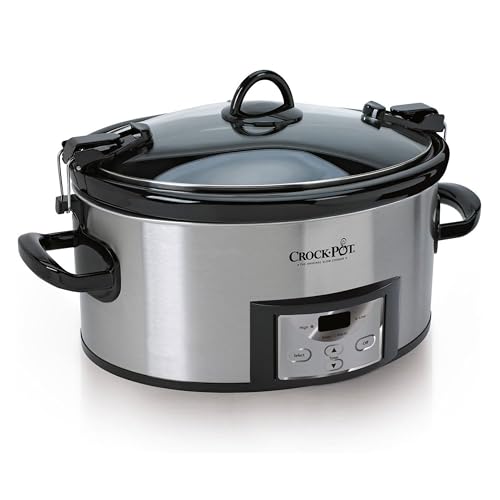
The single most impactful cooking appliance for chronic illness. Five to ten minutes of prep in the morning — seated, unhurried, at whatever pace your body allows — produces a full meal by evening with no additional standing, no monitoring, no returning to the stove. The locking lid makes it safe to transport to a table or countertop without spilling. For people whose energy runs lowest in the afternoon and evening — when a traditional dinner preparation would be required — a slow cooker redistributes that labor to the morning, when capacity is often higher.

This is the product that sounds trivial until the day it isn’t. A hands-free electric can opener requires no grip, no twisting, no sustained hand strength — you place the can, press one button, and the opener does the rest. For people with hand pain, grip weakness, arthritis, or any condition that makes the twisting motion of a manual can opener genuinely difficult, this is the difference between independence and assistance for a task that happens multiple times a week. In a clean white or stainless finish, it takes up minimal counter space.
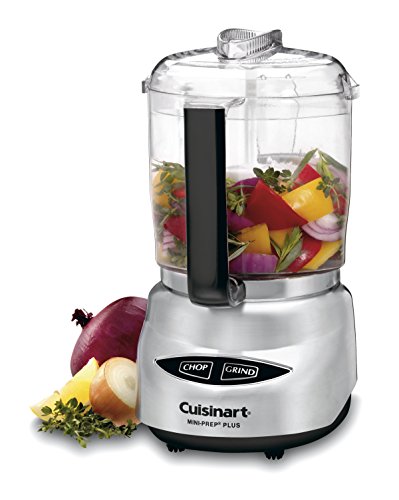
For the chopping, mincing, and slicing that accumulates across a cooking session into a significant wrist and hand load. A mini food processor handles garlic, onions, herbs, and soft vegetables in seconds with one button and no sustained knife work. The 4-cup size is manageable to lift and clean — important for people for whom a full-size food processor is too heavy to handle safely. The one-touch controls require no grip strength or fine motor precision. Rinse, dry, countertop storage — a complete cooking tool that earns its counter space.

Cookware weight is a variable most people don’t consider until they are managing it. A standard cast-iron skillet weighs ten to twelve pounds — empty. A stainless steel sauté pan can weigh six to eight. For someone with wrist instability, shoulder pain, or limited grip strength, lifting a heavy pan from a burner while its contents are hot is a genuine safety risk, not just a comfort issue. OXO’s lightweight non-stick line uses an aluminum construction that cuts pan weight significantly without sacrificing heat distribution — a pan you can actually manage on a hard day.
Making It Beautiful: Because Functional Doesn’t Mean Clinical
Everything described in this post so far has a functional purpose. And all of it can look like it was chosen with the same eye for beauty and intention as any other part of a LOVEOWE home. This is the part of the chronic pain kitchen conversation that almost never gets addressed — the assumption that an accessible, adapted kitchen is necessarily a medical-looking one. Grab bars in chrome. Plastic organizers in institutional white. Equipment that announces its purpose before you’ve had a chance to make your space your own.
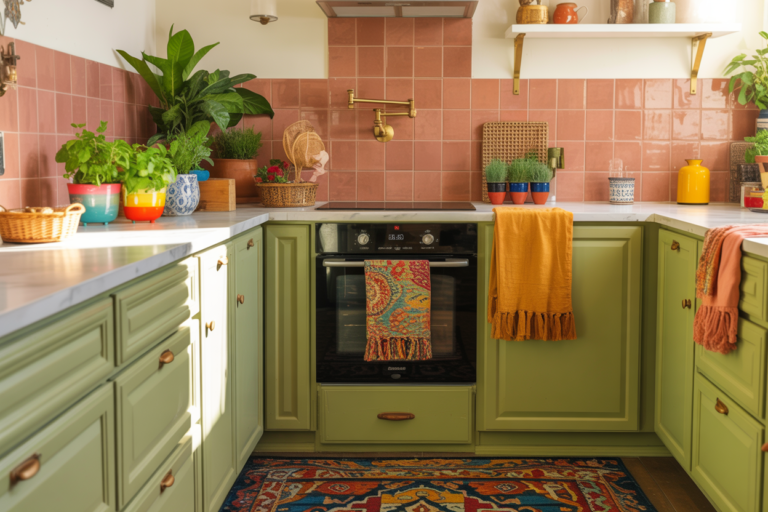
That assumption is worth refusing. A rolling kitchen cart in warm wood tones is a design feature. A lazy susan in a deep rattan finish is an aesthetic choice. An anti-fatigue mat in a neutral terracotta or sage is a kitchen textile as intentional as any other. A matte black support rail reads as architecture. The kitchen you build around your body’s needs does not have to look like a compromise. It can look like exactly what it is: a space that was designed with care, by someone who took their own needs seriously enough to meet them.
That is a form of self-worth expressed in square footage. It is a daily reminder, every time you move through a kitchen that works for you, that your body’s requirements are worth designing around — not designing despite.
The Finishing Edit: The Details That Make a Chronic Pain Kitchen Feel Like Yours
These four are the layer that makes everything else feel intentional — the details that complete a kitchen designed for chronic illness without making it look like one.

The elevated version of the organizational lazy susan — same rotating function, in a woven rattan or natural fiber finish that reads as a styling choice on any countertop or open shelf. Use it to corral oils, vinegars, and most-used condiments at counter height, rotating to reach rather than reaching over. The deep lip keeps items contained during rotation. In a warm natural finish, it looks like it belongs on the set of a beautifully styled kitchen shoot — which is exactly what a chronic pain kitchen deserves to look like.

The most overlooked textile in the kitchen and one of the easiest ways to make a functional space feel considered. Linen dish towels in warm neutrals — cream, sage, terracotta stripe — replace the utilitarian kitchen towel with something that looks like a choice. Hung on the leaning rail or oven handle, folded on the counter, they read as part of the kitchen’s visual language rather than as an afterthought. Linen also dries faster than cotton, which matters when hand-drying dishes is part of how you conserve energy by avoiding multiple trips to the dish rack.

For keeping food scraps contained during prep without repeated trips to the trash — which, on a hard day, is a movement that compounds. A ceramic countertop compost bin with a tight-fitting lid sits at the prep area and collects scraps as you go, eliminating the need to carry things across the kitchen mid-task. In a matte white, sage, or warm terracotta glaze, it looks like a kitchen object that was chosen deliberately. Empty it once, at the end of cooking, rather than making multiple trips during.

The finishing piece of a chronic pain kitchen — the one that says this space is alive, is cared for, belongs to someone who tends things. A self-watering herb planter at counter height means fresh herbs within arm’s reach without bending to a garden or walking to a market. The self-watering mechanism means the plants survive the days when tending them isn’t possible. In a terracotta or white ceramic finish, a small line of herb plants on the counter does more for the warmth and livability of a kitchen than almost any other single object — and it is functional in the most literal sense. It feeds you.
The Kitchen You Deserve
The kitchen I cook in now is not the kitchen I had before my illness changed what cooking cost me. It is smaller in some ways — fewer ambitious projects, fewer long Sunday afternoons at the stove for the pleasure of it. But it is better designed. It is designed for me, for this body, for this life. And that matters in a way I didn’t fully understand until I was standing in it — or sitting in it, on the days when sitting is what the body needs — and realizing that nothing in it was working against me.
That is what I want for you. Not a perfect kitchen, not a renovated one, not one that looks like a magazine spread if that isn’t what your life looks like right now. A kitchen that is organized around your actual range of motion, equipped with tools that reduce the effort cooking requires, furnished with the seats and supports that let you stay in the room long enough to finish what you started. A kitchen that knows you have chronic pain and was designed with that knowledge as the starting point rather than the afterthought.
You deserve to eat well. You deserve to cook, if cooking is something you love, without it costing you the next day. You deserve a kitchen that is on your side — functional and beautiful and unapologetically built around the body you actually have.
Start with the reorganization. It costs nothing and it changes everything. Then add, one piece at a time, what your body needs. Let the kitchen become what it should have been all along: a place where nourishing yourself is possible, even on the hard days. Especially on those.
You’ve built a kitchen that works for your body. Now let’s make sure the people around you understand what that body needs.
If there are conversations you’ve been putting off — with a doctor about what daily tasks actually cost you, with a partner about what help actually looks like, with yourself about what you’re allowed to need — Say This: 30 Scripts for Chronic Pain Communication is where those conversations start. Thirty scripts for thirty hard moments, written for the person who knows what’s true and needs the words to make someone else understand it. Because advocating for a life that works for you doesn’t stop at the kitchen door.