The Sacral Chakra: Reclaiming Pleasure, Creativity, and Flow When Your Body Makes Everything Harder
The content on this site was created with the help of AI. LOVEOWE LLC participates in the Amazon Services LLC Associates Program and other affiliate programs. As an Amazon Associate, I earn from qualifying purchases. This means I may earn a small commission—at no extra cost to you—when you make a purchase through links on this site. All opinions are my own. Learn more click here. Thank you for your support!
This is part of the LOVEOWE Chakra Series — seven posts exploring each energy center through the lens of chronic illness and pain. You can move through the series in any order. Each post stands on its own. New to chakras? Start with the series introduction here.
I remember the exact moment I realized how much chronic illness had taken from my relationship with pleasure.
It wasn’t a dramatic moment. I was sitting in my backyard on a summer afternoon — the kind of afternoon that used to feel easy and golden — and I noticed that I wasn’t enjoying it. I was monitoring it. Tracking whether the heat was too much. Calculating how much energy I’d spent getting outside and how much I had left. Managing the experience rather than being in it. The pleasure that used to arrive automatically, the simple animal joy of warmth and light and a slow afternoon, had been replaced by vigilance. And I didn’t know when that had happened, or how gradually, or how much of the rest of my life had been quietly hollowed out in the same way.
That is a sacral chakra wound. And it is one of the less-talked-about costs of living in a body shaped by chronic illness and pain.
The sacral chakra governs pleasure, creativity, flow, emotion, and joy — the quality of aliveness that makes life feel worth living rather than merely worth managing. Chronic illness doesn’t just cause pain. It interrupts the relationship with pleasure. It narrows the window of what feels accessible. It replaces spontaneity with calculation and joy with grief for the joy that used to be easier. Over time, a body in survival mode loses its relationship with delight — not because delight is gone, but because the nervous system has been too occupied with threat to make room for it.
This post is about making room again. About the specific, intentional work of reclaiming pleasure and creativity in a body that makes both harder — not by pretending the difficulty isn’t there, but by finding the flow that still exists within it, and by understanding that this reclamation is one of the most profound acts of self-love available to you.
What the sacral chakra is
The sacral chakra — Svadhisthana in Sanskrit, meaning “one’s own place” or “dwelling place of the self” — is the second of the seven primary chakras. It sits approximately two inches below the navel, in the lower abdomen, and its energy governs the hips, pelvis, reproductive organs, kidneys, and lower back — the body’s center of gravity, the physical location of both creation and pleasure.
Its element is water. This is the most essential thing to understand about the sacral chakra’s nature: water flows, adapts, finds its way around obstacles, and takes the shape of whatever contains it without losing its essential nature. The sacral chakra governs that same quality in us — the ability to move with life rather than against it, to feel and express emotions without being swept away by them, to remain fluid in the face of change. When we lose our fluidity, when we become rigid or frozen or dried up, that is a sacral chakra calling for attention.
Its color is warm orange — the color of embers and sunsets and ripe fruit, the color of warmth and abundance and the quality of a life being lived rather than merely endured. Its sound is VAM — a mantra whose vibration is felt in the lower abdomen, fluid and open. Its physical associations extend beyond the reproductive system to include the lymphatic system, the immune response, and the body’s relationship with water and flow at a cellular level.
The sacral chakra governs: pleasure and sensory experience, creative expression, emotional intelligence, intimacy and connection, the ability to receive as well as give, adaptability and change, and the relationship with desire — the simple, human experience of wanting things and allowing yourself to want them.
When balanced, the sacral chakra produces a felt sense of aliveness. Emotions flow freely without overwhelming. Creativity moves naturally. Pleasure is accessible and receivable — you can enjoy things without guilt, without calculation, without the monitoring that chronic illness trains into us. Relationships feel nourishing rather than draining. Life has texture and color.
When blocked: emotional numbness or volatility, creative blocks, guilt or shame around pleasure, difficulty receiving care or rest, and a pervasive sense that something essential is missing even when the practical details of life are in place.
The sacral chakra doesn’t ask you to perform joy. It asks you to make enough space for it that joy can find its way back when it’s ready.
The sacral chakra, chronic illness, and pain: what gets taken and what can be reclaimed
If the root chakra is wounded by the instability that chronic illness creates, the sacral chakra is wounded by the narrowing. The gradual reduction of life’s texture. The things that used to be possible and now aren’t, or aren’t in the same way. The relationship with pleasure that becomes complicated when the body that was once a source of it has become a source of suffering instead.
The pleasure wound. When the body is in pain, the nervous system is activated in ways that make pleasurable sensation harder to access — pain and pleasure compete for neurological bandwidth, and pain as a survival signal tends to win. Over time, the body becomes associated with suffering rather than enjoyment, and the automatic pathway to pleasure gets disrupted. This is not a character failing. It is a physiological consequence of living in pain, and it deserves to be addressed as such.
The creativity wound. Chronic illness takes energy. Creativity requires energy. This is a simple and devastating equation that most people who live with chronic conditions understand viscerally — the projects that got set aside, the art that stopped being made, the writing that dried up, the music that went unplayed. When all available energy goes toward basic function and symptom management, the creative impulse doesn’t disappear — it gets deferred. Month after month, year after year, until the deferral starts to feel permanent. Until you start to wonder if that creative part of you is still there, or whether it got lost somewhere in the years of managing.
It is still there. The sacral chakra is not destroyed by illness. It is compressed. The creative energy is still present — it is waiting, sometimes very patiently, for the conditions that allow it to move again.
The grief layer. One of the less-discussed aspects of sacral chakra wounding in chronic illness is grief — the specific grief of lost spontaneity, lost physical pleasure, lost creative output, the easy enjoyment of a body that moved without negotiation. This grief deserves to be held, not bypassed in the rush to reclaim things. Before the sacral chakra can hold joy again, it often needs to hold the sadness of what was lost. This is not a detour in the healing. It is the healing.
The water element and flow states. The sacral chakra’s element maps directly onto what chronic illness most disrupts: flow. The ability to lose yourself in making, movement, or connection is one of the deepest forms of pleasure available — and it is precisely what pain and constant self-monitoring interrupt. Healing the sacral chakra in a chronic illness context is partly about finding the conditions that can still produce flow states — smaller, gentler, differently shaped than before, but real.
Opening and healing the sacral chakra: practices for the chronic illness and pain body
Every practice in this series comes with a full version and an accessible version. The sacral chakra practices specifically are designed with the understanding that a body in pain has a complicated relationship with movement and sensation — these practices are not about pushing through. They are about gently, incrementally expanding the window of what feels safe and pleasurable in the body.
The orange light visualization meditation
The sacral chakra’s color is warm orange, and visualization practices that work with this color activate the chakra’s energy directly through the imagination — which, for the sacral chakra, is itself a healing act.
Full version (15–20 minutes): Find a comfortable position — seated or lying down. Close your eyes and take several slow breaths. Bring your attention to the space two inches below your navel. Visualize a warm, amber-orange light at this point — not harsh or bright, but the quality of candlelight or the last light before sunset. With each inhale, this light expands gently, warming the lower abdomen, spreading through the hips and pelvis. With each exhale, it releases any tension, any holding, any contraction that has accumulated there. If emotions arise — and they may, particularly grief or sadness held in this part of the body — let them move through without resistance. Stay with the visualization for as long as is available to you.
Accessible version (5 minutes): Lie down. Place one hand gently on the lower abdomen, below the navel. Feel the warmth of your own hand. Breathe slowly and imagine that warmth deepening with each breath — as though your hand is a gentle heat source, softening anything contracted underneath it. That’s the whole practice. The warmth, the breath, the attention. It is enough.
The VAM mantra
VAM (rhymes with “calm”) is the bija mantra of the sacral chakra — its seed sound. Chanting or silently repeating it creates a vibrational resonance that activates the sacral energy center and supports emotional release. The V sound specifically creates a movement quality — a vibration — that aligns with the sacral chakra’s water element and flow nature.
Sit comfortably. On your exhale, sound VAM — either aloud or as a silent internal vibration felt in the lower abdomen. Feel the sound as fluid and open rather than tight or controlled. Repeat for five to ten breath cycles. Pay attention to any shift in the quality of the lower body — warmth, release, softening — that the vibration produces.
Water practice — the simplest sacral healing available
Because the sacral chakra’s element is water, conscious engagement with water is one of the most natural and most accessible healing practices for this energy center. A warm bath or shower becomes a sacral chakra practice when it is approached with presence and intention rather than autopilot.
In a bath: Epsom salt for magnesium and pain relief, a few drops of sweet orange essential oil, flowers if you have them. Enter with intention — this is nourishment, this is your body receiving something warm and kind. Stay as long as your body allows.
In a shower: set an intention before turning on the water. Let it run over the lower abdomen. Notice the sensation without monitoring it. Let it be pleasurable if it wants to be.
On very hard days: a bowl of warm water for your feet, a warm cloth over the lower abdomen, a glass of water drunk slowly and with full attention. Water in any form, engaged consciously, is sacral chakra medicine.
Gentle creative expression — reclaiming the making
The sacral chakra is healed by making things. Not by making things well, or making things that will be seen by others, or making things that meet any standard of quality — simply by the act of creative expression itself. The nervous system’s relationship with creation is deeply connected to the sacral chakra’s health, and even small, private creative acts rebuild the pathways that illness and pain can interrupt.
This might look like: writing without an audience. Doodling with no goal beyond the sensation of pen on paper. Arranging flowers into something beautiful. Cooking a meal with pleasure rather than utility as the primary intention. Moving your body in whatever small ways are available — swaying, gentle hip circles while seated, anything pleasureful rather than therapeutic in its framing. The sacral chakra is activated by expression for its own sake, not for outcome. Begin there.
Tools for your sacral chakra practice

The sacral chakra bath practice is one of the most complete healing rituals in this series — water, warmth, magnesium absorption for pain and muscle relief, and the uplifting, creativity-activating scent of citrus all working simultaneously. Epsom salt with a citrus or orange blend is the single most useful purchase for sacral chakra work. Keep a bag beside the bath specifically for this practice.

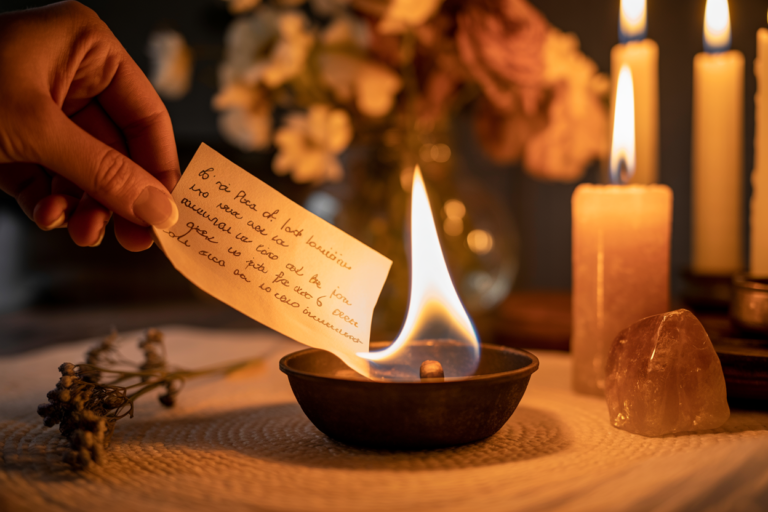
A warm orange candle lit during sacral chakra meditation, bath practice, or creative time anchors the practice in the chakra’s color and warmth. Orange in a ritual space signals to the body and the subconscious that this time is for pleasure and creation — a signal that chronic illness bodies particularly need, having spent so much time in spaces that signal only management and survival.

Sweet orange is the most directly sacral-aligned essential oil — uplifting, joy-activating, and associated with creativity and pleasure. Ylang-ylang is deeply sensual and emotionally opening. Sandalwood is warming and grounding, useful when the sacral chakra work brings up grief that needs to be held before it can be released. Diffuse during practice, dilute in a carrier and apply to the lower abdomen, or add a few drops to a bath.

A simple watercolor or art journaling set for the creative expression practice — something low-barrier enough to pick up without the self-consciousness that more elaborate art supplies can create. Watercolor specifically has an inherently fluid, water-aligned quality that suits sacral chakra work. The act of moving water and color across paper, with no goal beyond the sensation of making, is one of the most accessible creative healing practices available.
Crystals and ritual tools for the sacral chakra
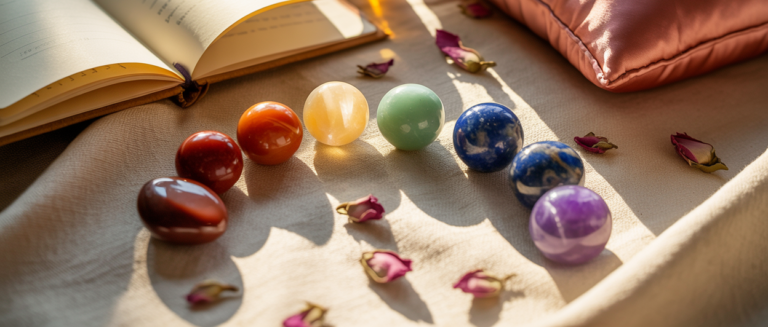
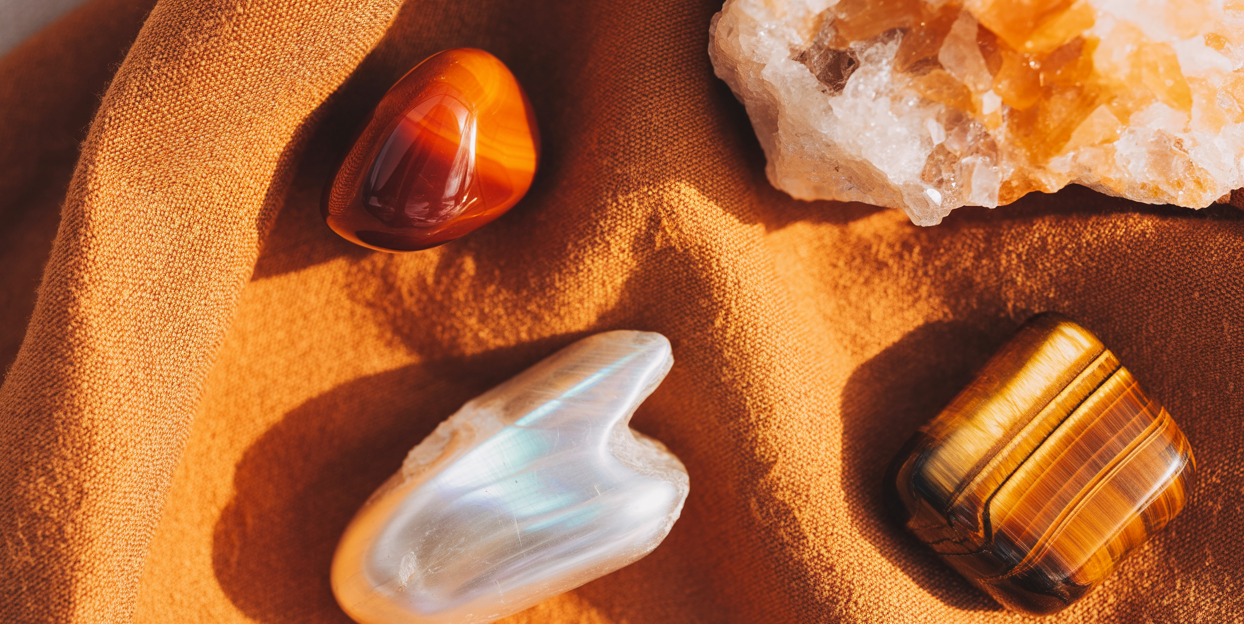
The sacral chakra’s crystal palette runs from warm orange through peach and gold, with the addition of moonstone — lunar, fluid, and deeply associated with the emotional and cyclical qualities this energy center governs. These are some of the most beautiful crystals in the chakra system, and their warmth and luminosity makes working with them a pleasure in itself, which is precisely aligned with what the sacral chakra is asking for.
Carnelian is the sacral chakra’s primary stone — warm, deeply orange, and associated with vitality, creativity, courage, and the activation of life force energy. For people with chronic illness and pain, carnelian’s most valuable quality is its reputation as an energy-activating stone — it is one of the few crystals specifically associated with motivation and physical vitality, making it useful on the low-energy days when the creative impulse is present but the energy to act on it isn’t. Hold it when you sit down to create something. Place it on the lower abdomen during meditation. Keep it in your work or creative space as a constant presence.
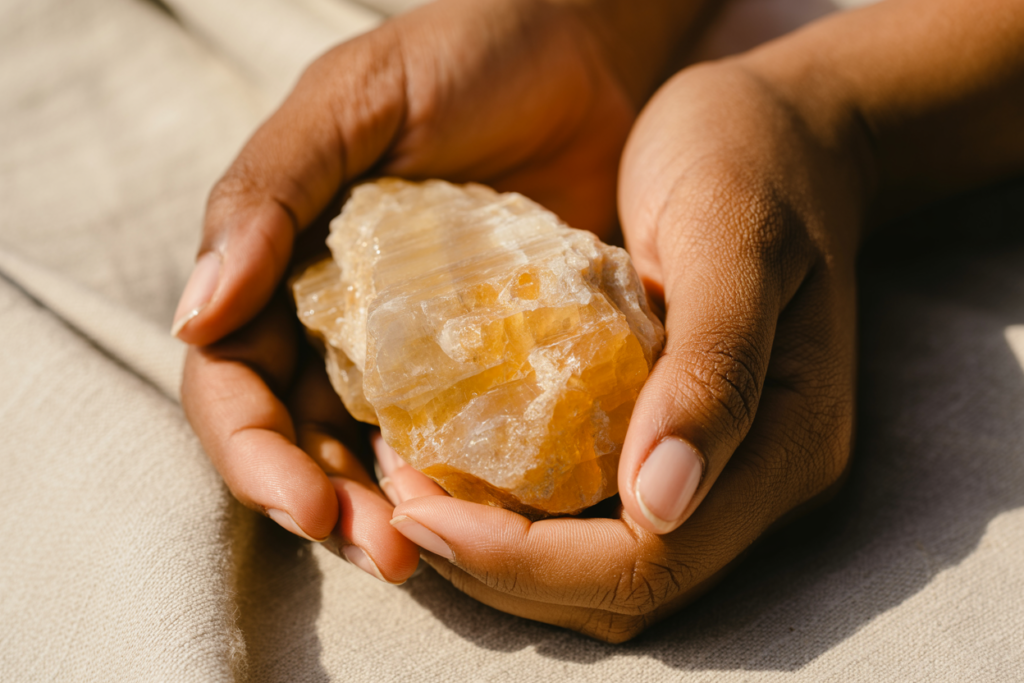
Orange calcite is softer and more emotionally soothing than carnelian — where carnelian activates, orange calcite dissolves. It is specifically associated with releasing emotional blocks, trauma stored in the body, and the kind of emotional stagnation that comes from long periods of illness and pain. For anyone carrying significant grief, shame, or emotional numbness in the sacral region, orange calcite is the gentler entry point — it works with what’s stuck rather than pushing past it. It is also one of the most beautiful crystals available, pale orange and luminous, and beauty is itself a sacral chakra healing.
Moonstone is the sacral chakra’s water stone — associated with the moon, with cycles, with the divine feminine, and with the emotional fluidity that is the sacral chakra’s essential nature. For people with chronic illness whose symptoms fluctuate cyclically — whether with hormonal cycles, weather, seasons, or the unpredictable rhythm of flares and remissions — moonstone offers a framework for relating to that fluctuation as something natural and workable rather than something to resist. It supports emotional regulation and the ability to move with life’s cycles rather than fighting them.
Tiger’s eye sits at the intersection of the sacral and solar plexus chakras — it brings the creative energy of the sacral together with the confidence and personal power of the solar plexus, making it particularly useful for people whose creative blocks are rooted not in lack of creative energy but in the self-doubt and fear that illness can cultivate. If what’s stopping you from creating is less “I have no ideas” and more “I’m afraid to try or to be seen,” tiger’s eye is the crystal for that specific work.
Amber — fossilized tree resin rather than mineral crystal — is warm to the touch in a way that stones are not, and this warmth is itself comforting. Associated with vitality, healing, and the transformation of pain into wisdom, amber carries a quality that resonates specifically with the chronic illness body.
Sacral chakra crystals worth adding to your practice

A substantial carnelian for the altar or for holding during creative practice. Look for deep, saturated orange-red rather than pale or washed-out tones — the richness of color generally reflects mineral quality. Raw carnelian has an earthy, unpolished warmth; tumbled pieces are smoother for extended holding. Keep one in the creative space specifically — beside the journal, near the desk, wherever the making happens.

Orange calcite in a raw chunk is one of the most visually striking and most affordable crystals available — soft, luminous orange that catches light beautifully. Its emotional-release quality makes it the right stone to place on the lower abdomen during lying-down sacral chakra meditation, or to hold during the journaling prompts that ask the harder questions about grief and loss. Let it do its dissolving work gently.

A smooth moonstone palm stone for holding during meditation or during moments of emotional intensity — the cool, pearlescent surface is grounding in a specifically soothing way. Look for pieces with visible adularescence, the internal glow that moonstone is known for. This quality is what gives it its association with the moon and with emotional depth.

A curated sacral chakra set gives you a complete working collection — activation, emotional release, emotional fluidity, and creative confidence in one grouping. Look for sets where pieces are substantial enough to work with rather than decorative chips, and that include at least one piece large enough for altar placement alongside smaller pieces for meditation and carrying.
Journaling prompts for the sacral chakra
Sacral chakra journaling goes to the places that chronic illness and pain often make difficult to visit — pleasure, desire, creative longing, grief for lost capacity, and the relationship with a body that has become complicated. These prompts are designed to be honest rather than aspirational. They don’t ask you to feel better than you do. They ask you to look clearly at what’s actually there, including what’s been lost and what might still be reclaimed.
Write without editing. The sacral chakra’s truth is fluid and sometimes messy — let it be.
For pleasure and the body:
- What did pleasure feel like before chronic illness or pain changed my relationship with my body? What specific things brought it?
- What relationship do I have with pleasure now? Have I stopped allowing myself to enjoy things, and if so, when did that start?
- What still feels good in my body — even now, even in the middle of all of this? What small pleasures are still accessible?
- What would it mean to allow myself to enjoy something fully, without monitoring, without guilt, without calculating the cost?
For creativity and expression:
- What did I used to create or make that I no longer do? What happened to that part of me?
- What creative thing am I afraid to try because I’m worried I can’t do it the way I used to?
- If I could make anything right now — with no concern for quality, audience, or output — what would it be?
- What is the smallest possible creative act I could do today? Not the most impressive — the most possible.
For grief and flow:
- What has chronic illness or pain taken from my experience of joy that I haven’t let myself fully grieve?
- Where in my life do I feel most stuck — most dried up, most unable to move? What would flow look like in that area?
- What am I holding onto — emotionally, physically, in terms of who I used to be — that might be ready to release?
- What new form of joy or pleasure is available to me now, in this body, in this life, that I haven’t fully allowed myself to receive?
For your sacral chakra journaling practice

A dedicated sacral chakra journal in a warm-toned cover — orange, peach, or terracotta — that belongs specifically to this work. The color alignment with the chakra is not just aesthetic: it creates a visual cue that this journal holds a particular kind of work, different from symptom tracking or daily planning. Lay-flat binding for ease of use on lower-energy days.

The sacral chakra practice of conscious water engagement — bath or shower — is one of the most generative for emotional insight and creative ideas. Having a waterproof notepad within reach means those insights don’t evaporate when you step out. Aqua Notes and similar waterproof notebooks are designed specifically for this — mounted to the shower wall or kept beside the bath.
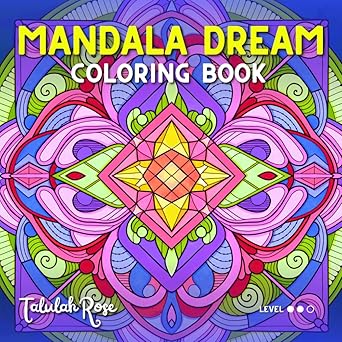
For days when words aren’t available but the creative impulse is present, a mandala or pattern coloring book is a direct sacral chakra practice — the repetitive, absorbing quality of coloring produces mild flow states, and the choice of color is itself a form of self-expression. Accessible on hard days, meditative rather than demanding, and complete enough to feel satisfying in short sessions.

The sacral chakra journaling prompts ask questions that may need to be approached from a reclining position — these are not always desk-and-chair questions. A cushioned lap desk makes journaling possible from wherever the body is most comfortable, which is itself an act of sacral chakra care: meeting yourself where you are rather than requiring yourself to come to a designated place.
Affirmations for the sacral chakra
Sacral chakra affirmations for the chronic illness and pain body are about reclaiming — reclaiming the right to pleasure, the right to creativity, the right to feel the full range of emotion including grief, and the right to joy that is not contingent on being well. They are not denial of difficulty. They are a practice of holding the difficulty and the desire for beauty simultaneously — which is exactly what the sacral chakra, at its healed best, knows how to do.
Say them aloud when possible. Feel them in the lower abdomen rather than the head. Say them especially on the flat days — the days when pleasure feels furthest away and the affirmation feels least true. Those are the days they are most needed.
- I deserve pleasure. Not when I am well. Not when I have earned it. Now, as I am.
- My creativity is not gone. It is waiting for space. I am making space.
- I allow myself to feel what I feel — including grief, including joy, including both at once.
- My body is still capable of pleasure, even in the middle of pain. I am open to finding it.
- I release what I have been holding in my hips, my belly, my lower back. I let it move through me.
- I am allowed to want things. I am allowed to desire a life that feels good.
- Joy does not require a healthy body. It requires a willing heart. My heart is willing.
- I am creative. I have always been creative. Illness has not taken that from me.
- I flow. Even slowly. Even with difficulty. I flow.
- I receive care, rest, beauty, and pleasure as easily as I give them.
Reclaiming pleasure and creativity is inner work. Advocating for yourself in the medical spaces that shape how much energy you have for both is the outer expression of the same self-love. Say This: 30 Scripts for Chronic Pain Communication gives you the exact language for 30 real situations — because you deserve to be heard in every room this season, not just the sacred one. Get your copy of SAY THIS here
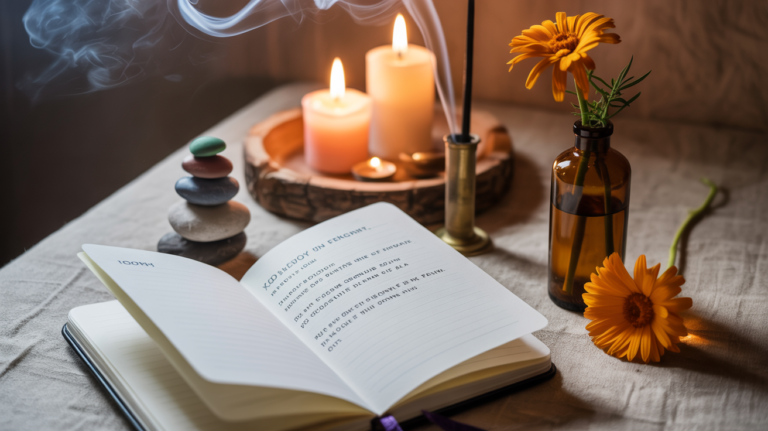
For creating your sacral chakra ritual space

A warm-toned altar tray for the sacral chakra arrangement — carnelian, an orange candle, a small vase of flowers, an affirmation card. Wood or terracotta finishes align with the warm, earthy-water quality of the sacral chakra better than cool metal or glass. This becomes the physical anchor of the practice — the place your attention returns to when you need to remember that this work is ongoing and belongs to you.

A singing bowl with a tone that feels warm and resonant rather than sharp or high — the lower, fuller tones align better with the sacral and lower chakras than very high-pitched bowls. Strike at the beginning and end of meditation or journaling practice. The sustained resonance of the sound mirrors the sacral chakra’s water quality — it continues, it flows, it gradually softens rather than stopping abruptly.

Fresh flowers on the altar or beside the practice space activate the sacral chakra’s relationship with beauty, sensory pleasure, and the natural world. Orange flowers — marigold, sunflower, bird of paradise, tiger lily — are the most directly aligned with the sacral chakra’s color and warmth. Dried flowers for the altar between fresh arrangements keep the space tended rather than empty.

A warm foot soak is the most accessible version of the sacral chakra water practice for people whose mobility, energy, or physical limitations make a full bath difficult. A basin of warm water with Epsom salt and a few drops of sweet orange essential oil, practiced with attention and intention rather than autopilot, is a complete sacral chakra healing ritual in fifteen minutes. This is the accessible version that belongs in every chronic illness self-care practice.
Pleasure is not a reward for being well
That is the central teaching of the sacral chakra for the chronic illness and pain body: pleasure is not something you earn by recovering. It is not a luxury for the days when symptoms are managed. Pleasure is medicine. Creativity is medicine. The experience of feeling genuinely alive in your body — even for five minutes, in small and gentle ways — is one of the most nervous-system-regulating, most profoundly healing things available to you. The sacral chakra is not asking you to pretend your life is easy. It is asking you to find the places where aliveness is still possible and to choose them, even on the hard days. Especially on the hard days.
Start with whatever is most possible today. A warm bath with intention. A few lines written in a journal with no audience. A carnelian held in the hand during five minutes of quiet. An orange candle lit while you rest. An affirmation spoken aloud that feels like a reach but not a lie.
These are not small things. They are the sacral chakra’s way of saying: I am still here. I am still flowing. There is still life in this body worth tending and celebrating and receiving.
There is. There always has been. And from the warmth and creativity of the sacral, we move next into the territory of personal power — into the solar plexus, where the question becomes not what brings you pleasure but what you are capable of, and how you reclaim your sense of that when illness has made it uncertain.
Next in the LOVEOWE Chakra Series: The Solar Plexus Chakra — Reclaiming Personal Power, Confidence, and Identity When Chronic Illness Makes You Question All Three