The Solar Plexus Chakra: Reclaiming Personal Power, Confidence, and Identity When Chronic Illness Makes You Question All Three
The content on this site was created with the help of AI. LOVEOWE LLC participates in the Amazon Services LLC Associates Program and other affiliate programs. As an Amazon Associate, I earn from qualifying purchases. This means I may earn a small commission—at no extra cost to you—when you make a purchase through links on this site. All opinions are my own. Learn more click here. Thank you for your support!
This is part of the LOVEOWE Chakra Series — seven posts exploring each energy center through the lens of chronic illness and pain. You can move through the series in any order. Each post stands on its own. New to chakras? Start with the series introduction here.
There is a version of yourself you remember from before.
Maybe before the diagnosis. Before the years of appointments and medications and the slow recalibration of what your life would look like. Before the body became something that required this much management. That version of you made decisions without second-guessing them for three days afterward. Took up space in a room without calculating whether you were too much. Had opinions about your own life and acted on them. Moved through the world with something that felt like authority — not arrogance, just the quiet confidence of a person who trusts themselves.
Chronic illness and pain are extraordinarily effective at dismantling that confidence — gradually, through a thousand small erosions. The plans cancelled because the body said no. The decisions made for you by symptoms rather than by what you want. The times you tried to advocate for yourself and were dismissed, or tried to predict how you’d feel and got it wrong. Over time, this builds into something: a fundamental uncertainty about your own competence, your own reliability, and your own worth as a person who is difficult to count on — most of all, for yourself.
That is a solar plexus chakra wound. And it is one of the most significant, most pervasive, and most quietly devastating things that chronic illness does to the people living with it.
This post is about understanding that wound specifically — not in the abstract language of self-doubt that most chakra content uses, but in the honest, specific language of what it is actually like to lose your sense of personal power to a body that doesn’t cooperate. And then about the real, practical work of reclaiming it — not the version of personal power that requires full health and full function, but the version that exists within and alongside and through the life you are actually living.
What the solar plexus chakra is
The solar plexus chakra — Manipura in Sanskrit, meaning “city of jewels” or “lustrous gem” — is the third of the seven primary chakras. It sits in the upper abdomen, between the navel and the bottom of the sternum, and is associated with the digestive system, the liver, the pancreas, the adrenal glands, and the entire metabolic process by which we convert raw material — food, experience, challenge — into energy and action.
Its element is fire. This is the most important thing to understand about the solar plexus chakra’s nature: fire transforms. It takes what is raw and makes it something else. The solar plexus is the place in our energy system where experience gets processed — where challenge gets converted into resilience, where difficulty gets turned into wisdom, where the raw material of a hard life gets alchemized into something useful. When this chakra is healthy, we don’t just survive difficulty — we metabolize it. We extract from it what is valuable and release what is not.
Its color is bright yellow — the color of sunlight, of gold, of the sun at noon. Its sound is RAM — a mantra whose vibration is felt in the upper abdomen, activating and warming. Its physical associations include the digestive system specifically, which is why digestive disruption — bloating, nausea, IBS-type symptoms, appetite changes — is so consistently associated with solar plexus imbalance. The gut and the solar plexus chakra are in constant conversation.
The solar plexus governs: personal power and will, self-esteem and self-respect, confidence and assertiveness, the ability to make decisions and act on them, identity and individuality, the right to take up space and have needs, and the metabolic process — physically and energetically — of turning experience into growth.
When balanced, the solar plexus produces a felt sense of capability. You trust yourself. You make decisions without agonizing. You can say no without prolonged guilt. You know who you are — your values, your preferences, your limits — and you act from that knowledge rather than from fear. You are, in the most grounded sense, yourself.
When blocked: self-doubt, difficulty making decisions, excessive people-pleasing, shame, and a pervasive uncertainty about your own competence and reliability. When overactive — a common compensatory response to deep insecurity — it manifests as control, rigidity, and the relentless need to prove yourself.
Personal power is not the absence of limitation. It is the ability to know yourself clearly, act from that knowledge, and trust your own judgment — including and especially in the middle of difficulty.
The solar plexus, chronic illness, and pain: what gets taken and what persists
The solar plexus chakra governs autonomy, identity, and the sense that you are capable of directing your own life. Chronic illness attacks all three of these simultaneously and systematically. The result is a solar plexus wound that runs deep — and that is rarely named or addressed in the medical conversations that dominate so much of chronic illness life.
The autonomy wound. Chronic illness removes autonomy in ways that are both practical and profound. At the practical level: your schedule is no longer fully your own, your diet is constrained, your activities are limited, your social commitments are uncertain. At the profound level: your body makes decisions without consulting you. Pain arrives uninvited. Fatigue overrides your intentions. Symptoms rearrange your day, your week, your year. The cumulative experience of having your plans regularly superseded by your body creates a specific kind of powerlessness — one that the solar plexus chakra feels acutely, because autonomy and will are precisely what this energy center holds.
The competence wound. Chronic illness quietly erodes the sense of competence — the belief that you are reliable, capable, and able to be counted on. When you cancel plans frequently enough, your self-image shifts. When brain fog makes you unable to complete tasks you used to handle easily, it is difficult not to internalize that as a personal failing rather than a medical symptom. The solar plexus wound here is not about actual incompetence — it is about the erosion of the self-concept of competence, which is a different and more treatable problem.
The identity question. Who are you when your body is the primary fact of your existence? Chronic illness has a way of making the illness the center of the identity — not because we choose this, but because it demands so much of our attention, our time, and our resources that it can colonize the self-concept. The solar plexus chakra governs the part of us that is distinct from our condition — our values, our interests, our humor, our opinions, our particular way of being in the world that exists regardless of our diagnosis. Reclaiming that distinct identity, separate from and alongside the illness, is solar plexus work.
The self-advocacy loop. There is a painful circularity here: chronic illness damages personal power, which makes it harder to advocate effectively in medical settings, which leads to dismissal and poorer care, which further damages personal power. Breaking this loop — rebuilding the confidence to ask clearly, to push back, to insist on being heard — is solar plexus healing with direct consequences for health outcomes.
The fire element and digestion. The solar plexus chakra’s element, fire, governs transformation and metabolism — and the digestive system is its primary physical expression. Many chronic illness conditions directly affect the digestive system: IBS, Crohn’s, gastroparesis, the digestive effects of chronic pain and stress, and the side effects of many medications. When the gut is chronically stressed or disrupted, the solar plexus chakra registers this physiologically as well as energetically. Supporting digestive health is, in the framework of this series, also supporting personal power.
Opening and healing the solar plexus chakra: practices for the chronic illness and pain body
Every practice in this series comes with a full version and an accessible version. The solar plexus practices in particular are designed with the understanding that a body managing chronic illness may have a complicated relationship with its own strength and capacity — these practices are not about pushing through, proving yourself, or performing wellness. They are about reconnecting, gently and specifically, with the sense of your own capability and identity.
The golden sun visualization meditation
The solar plexus chakra responds powerfully to visualization involving warmth, light, and the color yellow — the color of sunlight and the quality of fire that transforms rather than destroys.
Full version (15–20 minutes): Find a comfortable position — seated or lying down. Close your eyes. Take several slow breaths, extending the exhale. Bring your attention to the upper abdomen, the area between your navel and the bottom of your sternum. Visualize a warm, golden-yellow light at this point — the quality of midday sunlight, warm and steady and capable. With each inhale, this light expands, warming the entire abdominal area. With each exhale, feel any contraction, any held self-doubt, any tension in this part of the body softening and releasing. Imagine the light as your own inner fire — the part of you that knows what it thinks, knows what it wants, and acts from that knowledge. Stay as long as is available.
Accessible version (5 minutes): Lie down. Place both hands over the upper abdomen. Feel the warmth of your own hands on this area. Breathe slowly. On each exhale, release any holding in this part of the body — any sucking in, any bracing, any tension that has accumulated from chronic vigilance. Let this part of your body simply be, held warmly by your own hands. That’s enough.
The RAM mantra
RAM (rhymes with “calm”) is the bija mantra of the solar plexus chakra — its seed sound. The R sound is activating; the AM grounds the activation into the body. Chanting RAM creates a vibration specifically felt in the upper abdomen, directly activating the energy center it belongs to.
Sit comfortably with your spine reasonably upright — this is the one practice in the series where posture genuinely matters, because the solar plexus is the chakra of uprightness, of taking up space with the body. On your exhale, sound RAM — either aloud, at whatever volume is available, or as a silent internal vibration felt in the upper abdomen. Feel the R activate, feel the AM settle. Repeat for five to ten breath cycles. Notice the quality of the upper abdomen — any warmth, any opening, any shift in how this part of the body feels.
Diaphragmatic breathing for solar plexus activation
Deep belly breathing directly activates the solar plexus region — the diaphragm moves through the space this chakra governs with every breath, and conscious, deliberate breath in this area is one of the most immediate interventions available for both anxiety (a solar plexus symptom) and digestive distress (a solar plexus physical manifestation).
The practice: Sit or lie down. Place one hand on the upper abdomen, above the navel. Inhale slowly through the nose for a count of four, allowing the upper abdomen to rise and push your hand outward — this is the diaphragm descending, creating space. Hold briefly. Exhale through the mouth for a count of six or eight, allowing the abdomen to fall. Repeat for five to ten cycles. The extended exhale activates the parasympathetic nervous system — it is the breath pattern of safety rather than threat, which is precisely what the anxious, self-doubting solar plexus needs.
For people with respiratory limitations or pain that makes deep breathing difficult: any degree of breath attention in this area is beneficial. Even placing a hand on the upper abdomen and noticing the natural breath movement there — without trying to change it — is a solar plexus awareness practice.
Intentional decision-making as daily solar plexus practice
The solar plexus heals through action — through the experience of making decisions, acting on them, and discovering that your judgment can be trusted. For people with chronic illness, the scale of this practice needs to be adjusted. The goal is not sweeping life decisions but the small, daily recovery of choice.
This looks like: noticing when you defer automatically and asking yourself what you actually want first. Making one small decision each day entirely from your own instinct. Choosing something — a meal, a rest time, a piece of clothing — based solely on what you want. These are microscale exercises in trusting your own knowing, and they are the foundation of rebuilt personal power.
The solar plexus also heals through advocacy — expressing your needs in the spaces where that has been difficult. The appointment where you ask for what you need and don’t back down. The conversation where you say this is what my experience actually is. The moment where you act from your own authority rather than waiting for permission.
Tools for your solar plexus practice

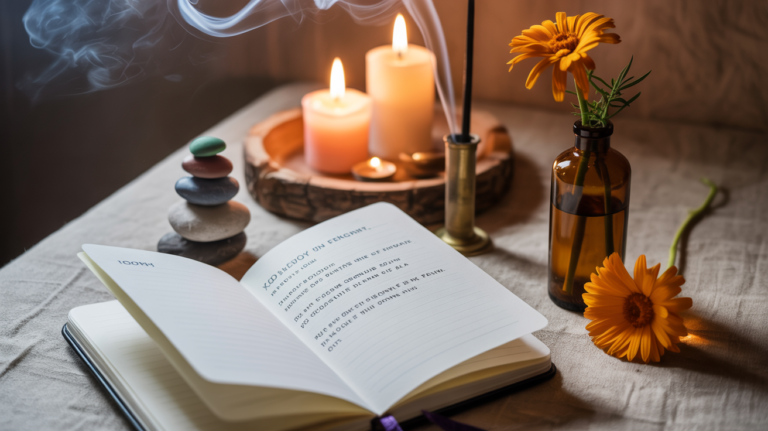
A warm yellow candle lit during solar plexus meditation, journaling, or intentional decision-making practice anchors the practice in the chakra’s fire and warmth. Yellow in a ritual space activates the quality of confidence and clarity associated with this energy center. The act of lighting it with intention — this is my time, this is my practice, this belongs to me — is itself a small act of solar plexus healing.
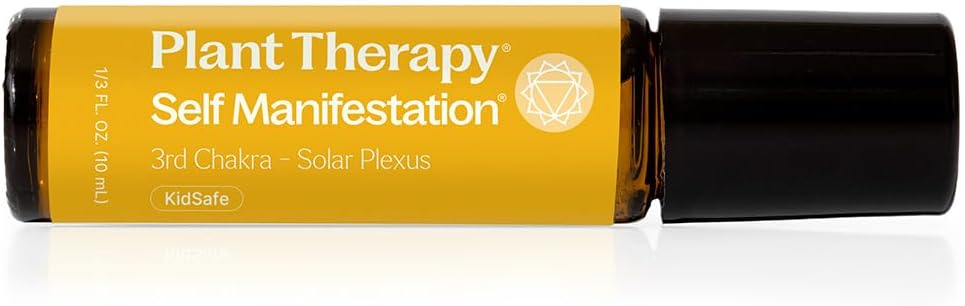
Lemon essential oil is bright, activating, and associated with mental clarity and confidence. Ginger is warming and digestive — directly supportive of the solar plexus’s physical domain. Black pepper is energizing and courage-activating in aromatherapy tradition. Diffuse during practice, apply diluted to the upper abdomen, or inhale directly when you need to access clarity and decisiveness quickly.

A flexible heating pad positioned over the upper abdomen during solar plexus meditation serves both physical and energetic purposes simultaneously — warmth directly at the chakra’s location, combined with the pain and digestive relief that heat provides for the many chronic illness conditions that affect this region. Physical comfort and energetic activation in the same tool.

The solar plexus chakra’s physical domain is the digestive system. Supporting digestion through herbal tea — chamomile for digestive calm, fennel for bloating and cramping, ginger for nausea and motility — is a practical, daily form of solar plexus care that most people with chronic illness are already familiar with. Drinking it deliberately, as a ritual rather than just a remedy, adds the intentional dimension that transforms self-care into chakra practice.
Crystals and ritual tools for the solar plexus chakra
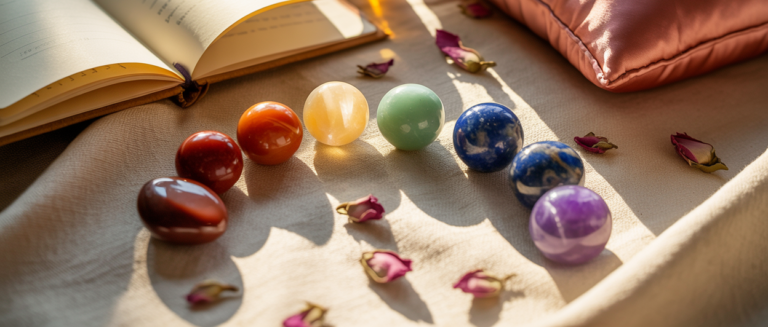
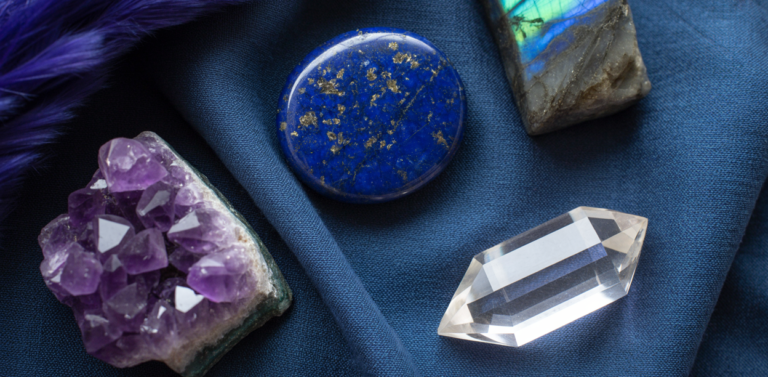
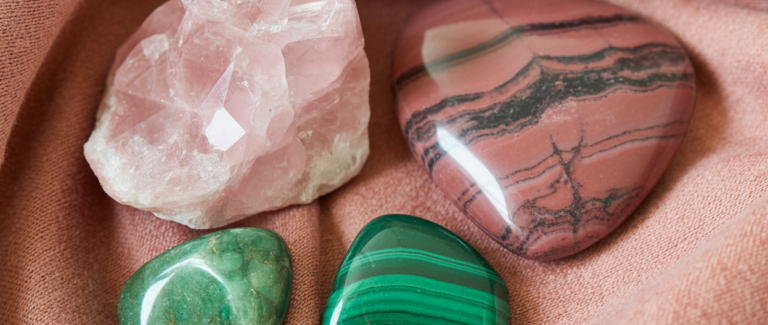
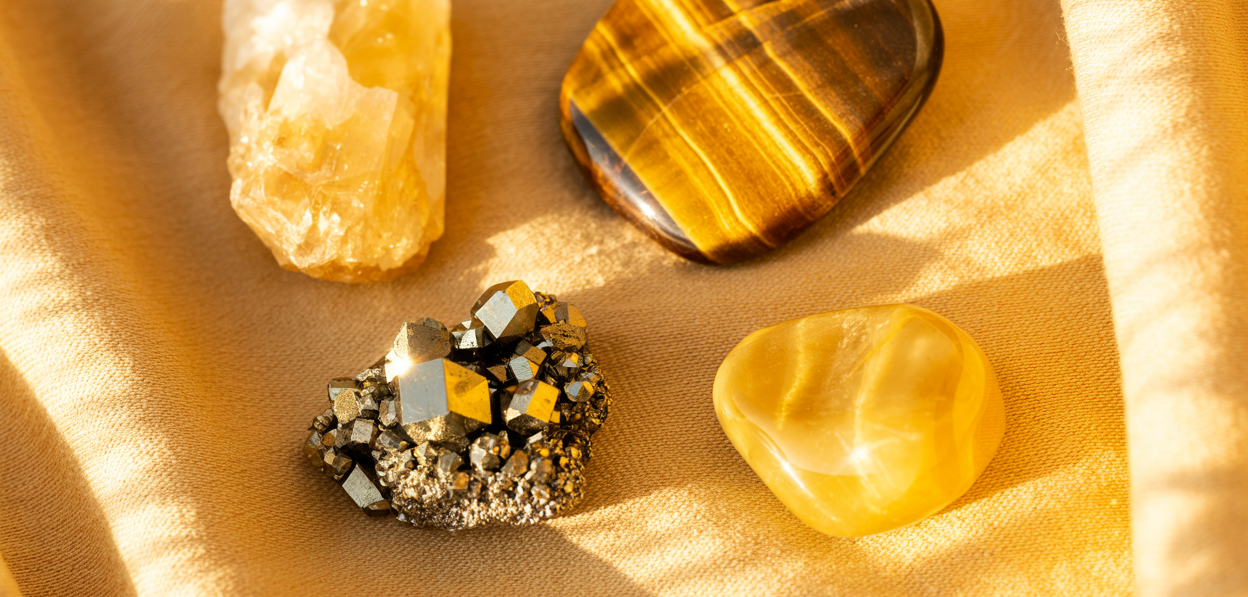
The solar plexus chakra’s crystal palette runs through warm yellow and gold — the colors of sunlight, of abundance, of fire caught in stone. These are some of the most immediately uplifting and energetically activating crystals in the system, and their warmth and brightness makes them pleasant to work with even on the days when energy is low and the practice needs to be as effortless as possible.
Citrine is the solar plexus chakra’s primary crystal — known historically as the “merchant’s stone” and the “stone of success,” associated with confidence, abundance, motivation, and the clearing of negative energy patterns. For people with chronic illness and pain, citrine’s most valuable quality is its reputation as one of the few crystals that does not accumulate negative energy and does not need cleansing — it is perpetually self-clearing, which suits the energy of a person who may not have the capacity for elaborate crystal maintenance. Place it in your work or creative space, hold it during decision-making moments, or keep it where you’ll see it during the parts of the day when self-doubt tends to peak.
Tiger’s eye sits at the intersection of the solar plexus and root chakras — grounding and empowering simultaneously, associated with courage, confidence, and the ability to act under pressure. For people with chronic illness whose confidence has been eroded by years of managing uncertainty, tiger’s eye offers a specific quality of grounded courage — not the reckless confidence that ignores limitation, but the steady, clear-eyed confidence that acts anyway, knowing what it knows and trusting that knowledge. Hold it during medical appointments, during conversations that require you to advocate for yourself, during any moment that requires you to take up space.
Yellow jasper is a gentler solar plexus crystal than citrine or tiger’s eye — associated with protection, positive energy, and the slow, steady building of self-confidence rather than its dramatic activation. For people whose solar plexus wound is deep or longstanding, yellow jasper is the more appropriate entry point — it supports healing at a pace that doesn’t overwhelm. It is also associated specifically with protection during challenging experiences, including medical procedures and difficult appointments.
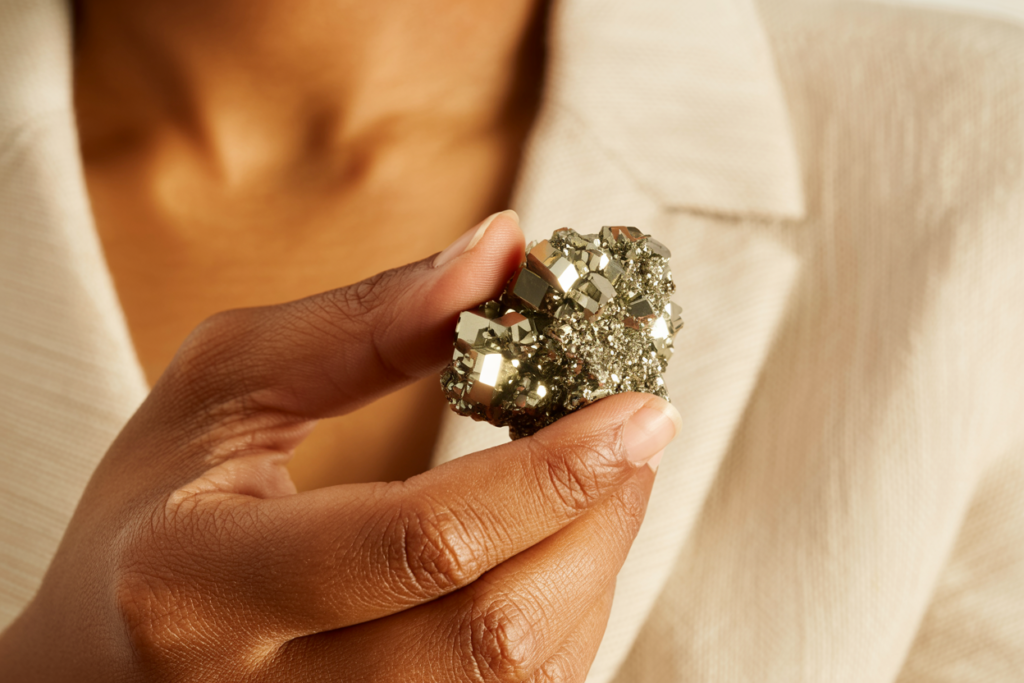
Pyrite — fool’s gold, though the name undersells it — is the solar plexus crystal of willpower and inner strength, associated with taking action and the confidence to move forward in the face of uncertainty. Its reflective quality is also specifically associated with reflecting negativity rather than absorbing it — useful for anyone who has absorbed years of dismissal and disbelief. Pyrite reflects back rather than takes in.
Sunstone bridges the sacral and solar plexus chakras, carrying joy and creativity alongside confidence and identity. For anyone whose personal power wound is tangled with sacral chakra depletion, sunstone works across both energy centers at once.
Solar plexus crystals worth adding to your practice

Natural citrine ranges from pale yellow to warm honey-amber — distinct from the deep orange of heat-treated amethyst often sold as citrine. A raw citrine point for the altar or desk, and a tumbled piece for carrying. Its self-clearing quality makes it low maintenance — it does not need regular cleansing the way most other crystals do, which suits the chronic illness body that may not always have energy for elaborate crystal care rituals.
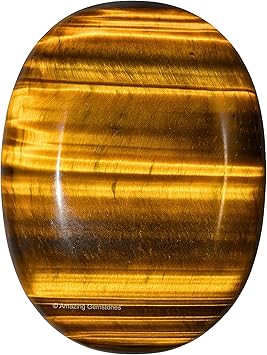
A smooth tiger’s eye palm stone for holding during moments that require grounded confidence — appointments, conversations, decisions. The striated gold and brown of tiger’s eye makes it visually distinctive and immediately recognizable; its weight in the hand is grounding and its warmth is reassuring. Keep one in the bag you bring to medical appointments specifically.

A small pyrite cluster for the altar — its reflective, metallic-gold surface catches light in a way that is immediately uplifting, and its association with willpower and forward action makes it the right stone to see at the beginning of a day that requires courage. Pyrite clusters are also one of the most visually striking altar additions available, which matters for a chakra whose healing is partly aesthetic — the sense that your space reflects your worth.

A curated solar plexus set covering the full range of this chakra’s crystal support — activation and abundance (citrine), grounded courage (tiger’s eye), gentle confidence building (yellow jasper), and willpower and protection (pyrite). Look for sets where pieces are substantial rather than decorative chips, with at least one piece large enough for altar placement.
Journaling prompts for the solar plexus chakra
Solar plexus journaling goes to the most identity-level questions — who you are, what you believe about your own worth and capability, and what chronic illness has done to both. These prompts are written for honesty rather than positivity. They do not ask you to feel more capable than you currently do. They ask you to look clearly at what has happened to your sense of self, and to find what has persisted through all of it.
Write without censoring. The solar plexus speaks in clear, direct language — let yours be direct too.
For personal power and autonomy:
- In what areas of my life does chronic illness or pain make my choices for me? How does that feel — what does it cost me beyond the practical inconvenience?
- When did I last make a decision entirely from my own instinct, without consulting anyone or second-guessing myself? What was that like?
- Where in my life am I waiting for permission that only I can give myself?
- What would I do differently if I fully trusted my own judgment?
For identity and self-worth:
- Who am I beyond my diagnosis? What are the parts of me that exist regardless of my health status?
- What has chronic illness taken from my sense of competence and reliability? What has it not been able to take?
- If someone who knew nothing about my illness described me based on who I actually am — my values, my humor, my perspective — what would they say?
- What do I believe about my own worth on hard days? Is that belief true, or is it the illness talking?
For confidence and self-doubt:
- Where does my self-doubt specifically live? What triggers it most reliably, and what does it tell me about myself?
- What is one thing I know — genuinely, clearly know — about my own experience that I haven’t fully trusted or acted on?
- What would I say to myself right now if I spoke with the confidence of someone who had never been doubted?
- What does reclaiming my personal power look like in the life I actually have — not a future healthier life, but this one, now?
For your solar plexus journaling practice

A dedicated solar plexus journal in a warm, confident color — gold, amber, or bright yellow — that signals to the subconscious that this is the space for clarity, directness, and self-knowing. Lay-flat binding for ease on lower-energy days. This journal holds the identity work — the questions of who you are and what you know — and should feel like an object worthy of that work.

Writing solar plexus journal entries in gold or yellow ink — available in gel pen form — adds a visual dimension to the practice that aligns with the chakra’s color. This is a small and entirely optional detail that many people find makes the practice feel more intentional and more celebratory, which is what the solar plexus needs: the sense that your inner work is worth marking with something beautiful.

A card deck focused specifically on self-worth, personal power, or identity — drawn at the start of a journaling session as an orientation for the day’s writing. Solar plexus journaling can be activating in ways that benefit from a grounding prompt to begin. A card drawn with intention, placed beside the journal while writing, keeps the practice anchored in a specific quality of self-knowing rather than drifting into general processing.

Solar plexus journaling is work that sometimes benefits from a more upright position — the chakra of will and identity is associated with uprightness, with taking up space — but chronic illness bodies don’t always have access to a chair and desk. A firm-surfaced lap desk with a cushioned base makes writing possible from a semi-reclined or elevated position that is accessible without compromising the quality of the practice.
Affirmations for the solar plexus chakra
Solar plexus affirmations for the chronic illness and pain body are about reclamation — of identity, of capability, of the authority to define your own experience and to trust your own knowing. They are specifically designed to address the solar plexus wounds that chronic illness creates: the competence wound, the autonomy wound, the identity question. They do not ask you to pretend you are fully well. They ask you to find the personal power that exists within and alongside the illness.
Say them standing if possible — even briefly, even for thirty seconds. The solar plexus chakra responds to upright posture, to the physical experience of taking up space in the body. If standing isn’t available, sit as tall as the body allows. Feel the words in the upper abdomen rather than the head. Say them with whatever conviction is available to you, knowing that conviction grows with repetition.
- I am more than my diagnosis. My identity is not my illness.
- I trust my own judgment. My knowing is valid.
- I am capable. Illness has changed what I can do, not who I am.
- I have the right to take up space, to have needs, to be difficult to manage. I am not too much.
- My limitations do not define my worth. My worth is not conditional on my function.
- I reclaim my authority over my own experience. I know what I feel and what I need.
- I am allowed to say no. I am allowed to say yes. Both are expressions of my power.
- I act from my own knowing, not from fear of judgment.
- I am reliable to myself. That is the most important reliability there is.
- I am building personal power in the life I actually have. That is enough. I am enough.
Reclaiming personal power starts with the inner work of believing yourself. It continues in the rooms where your health decisions get made — where you advocate clearly, hold your ground, and speak from the authority of your own experience. Say This: 30 Scripts for Chronic Pain Communication gives you the exact language for 30 real situations, so the confidence you’re rebuilding here has words to move through. Get your copy of SAY THIS
For creating your solar plexus ritual space

A warm-toned altar tray for the solar plexus arrangement — citrine, a yellow candle, a pyrite cluster, an affirmation card with today’s chosen statement. The tray defines the space as intentional, and returning to it daily reinforces the commitment to the inner work. A gold-toned or natural wood tray suits the solar plexus’s fire element better than cool metal or glass.

A singing bowl with a warm, full tone to open and close solar plexus practice sessions. The sound creates a ritual container — this time begins here, this time ends here — that supports the solar plexus chakra’s need for clear structure and defined intention. Strike once at the start of meditation or journaling and once at the close, letting the sound settle completely before moving on.

Sunflowers are the solar plexus flower — their name, their color, their orientation toward light all align with the chakra’s fire element and solar energy. A vase of sunflowers on the altar or beside the practice space activates the solar plexus visually and brings the energy of abundance and warmth into the space. Dried sunflowers or marigolds between fresh arrangements keep the space tended.

A warm cup of lemon or citrus tea drunk with presence and intention at the start of solar plexus practice — before the journaling, before the meditation — is a simple ritual that activates the chakra’s yellow energy and supports the digestive system simultaneously. The act of choosing something nourishing, preparing it, and drinking it deliberately rather than on autopilot is a daily, micro-scale act of solar plexus self-care.
The power that was never fully gone
The version of yourself from before — the one who made decisions without agonizing, who moved through the world with something like authority — that person did not disappear. They got buried. Under years of illness and limitation and the slow erosion of confidence that comes from living in a body that doesn’t cooperate.
But buried is not gone. Personal power is not destroyed by chronic illness. It is compressed, obscured, pushed down under layers of self-doubt and grief and the accumulated weight of having your experience questioned by people who were supposed to help. It is still there. The solar plexus chakra still holds it. The fire is still lit, even when it’s low.
The work of this chakra is the work of returning to that fire — of learning, again, to trust your own knowing, to act from your own authority, to define yourself by something more true and more durable than what your body can or cannot do on any given day. It is the work of reclaiming the identity that exists alongside and beyond the illness, and of rebuilding the confidence to advocate for that person in every space that matters.
Start small. Light a candle. Write one sentence in your journal from the authority of your own knowing. Say one affirmation standing up, even for thirty seconds. These are not metaphors. They are solar plexus activations — tiny, real, cumulative acts of reclaiming the sense that your inner fire is still burning and that it still matters.
It does. You do.
From the personal power of the solar plexus — from the reclaimed sense of self, capability, and identity — we move next into the territory of love. The heart chakra is where the question becomes not what you are capable of or who you are, but how you love and are loved — and how you rebuild that capacity in a body and a life that has given you so many reasons to close.
Next in the LOVEOWE Chakra Series: The Heart Chakra — Learning to Love a Body That Hurts, a Life That Changed, and Yourself Through All of It