The Heart Chakra: Learning to Love a Body That Hurts, a Life That Changed, and Yourself Through All of It
The content on this site was created with the help of AI. LOVEOWE LLC participates in the Amazon Services LLC Associates Program and other affiliate programs. As an Amazon Associate, I earn from qualifying purchases. This means I may earn a small commission—at no extra cost to you—when you make a purchase through links on this site. All opinions are my own. Learn more click here. Thank you for your support!

This is part of the LOVEOWE Chakra Series — seven posts exploring each energy center through the lens of chronic illness and pain. You can move through the series in any order. Each post stands on its own. New to chakras? Start with the series introduction here.
Nobody tells you that chronic illness can break your heart in this specific way.
Not the obvious heartbreak — the grief over lost plans, the mourning of the life you expected. That one gets talked about, at least sometimes. The heartbreak I mean is quieter and stranger: the fracturing of the relationship between you and your own body. The way a body that has caused you enough pain, enough limitation, enough disruption can start to feel less like home and more like an adversary. Something you are in conflict with. Something you have to manage and fight and endure rather than inhabit.
And then there is the other layer: what chronic illness does to your capacity to receive love. The way years of needing care — from partners, from family, from friends, from medical systems that often fall short — can create a complicated mix of guilt and gratitude and the exhausting sense that you are too much, that you ask too much, that love from others comes with a weight you didn’t earn. The difficulty of receiving openly when you’ve spent so long trying not to be a burden.
All of this lives in the heart chakra. The fracturing relationship with your own body, the complicated receiving of others’ love, the grief that hasn’t been fully honored, the forgiveness that hasn’t been extended — to the body, to the people who let you down, to yourself for all the ways you’ve been less than you wanted to be. The heart chakra is where the deepest emotional work of chronic illness lives, and it is where some of the most significant healing is available.
This is the post where we go there.
What the heart chakra is
The heart chakra — Anahata in Sanskrit, meaning “unstruck,” “unhurt,” or “unbeaten” — is the fourth of the seven primary chakras and the one that sits at the center of the system. It is the bridge between the three lower chakras, which govern our physical and personal reality, and the three upper chakras, which govern our communication, intuition, and spiritual connection. This central position is not incidental: love is what connects the physical to the spiritual, the personal to the universal, the self to the other.
Its location is the center of the chest, at the level of the heart and the sternum. Its physical associations include the heart and cardiovascular system, the lungs, the immune system, the thymus gland, the shoulders, arms, and hands — the parts of the body literally associated with holding, reaching, and embracing. Its element is air — invisible, necessary, connecting everything to everything, moving freely without boundary.
Its color is green — the color of healing, of growth, of living things. And also, in its higher expression, pink — the color of self-love, of tenderness, of the particular quality of compassion that begins with and returns to the self. Both colors belong to this chakra. Both qualities are required for its healing.
Its sound is YAM — a mantra whose vibration is felt in the chest, opening and expanding. Its quality, when balanced, is the particular warmth of a heart that is genuinely open — not naive, not without boundaries, but genuinely capable of both giving and receiving love in ways that nourish rather than deplete.
The heart chakra governs: love in all its forms, compassion and empathy, forgiveness of self and others, grief and the ability to move through it, the capacity to receive as well as give, connection and intimacy, the integration of joy and pain as parts of a full life, and the particular quality of self-love that is not performance or affirmation but something quieter and more fundamental — the felt sense that you are worthy of care.
When balanced, the heart chakra produces genuine warmth. You can give without depletion and receive without guilt. Forgiveness feels possible — not as a performance of virtue but as a genuine release. Grief can be honored without becoming a permanent residence. There is a quality of okayness underneath everything — the sense that even in difficulty, you are fundamentally alright, and that love is available to you.
When blocked: contraction, emotional numbness or overwhelm, difficulty giving or receiving love, grief with nowhere to go, inability to forgive. Isolation disguised as self-sufficiency. And in the chronic illness context specifically: the complicated, painful relationship with a body that has become the source of suffering rather than the vehicle of joy.
Anahata means unstruck — not untouched, not unpained, but unhurt at the deepest level. The heart chakra holds the part of you that has not been broken by everything that has tried to break it. That part is real. And it is where healing begins.
The heart chakra, chronic illness, and pain: the specific wounds and where healing lives
The heart chakra is where chronic illness lands its most intimate wounds — the ones that don’t show on tests or scans, the ones that take the longest to name, the ones that most medical conversations never reach. These are the wounds worth addressing directly.
The body relationship wound. Of all the losses chronic illness creates, the loss of a loving relationship with your own body is one of the least discussed and most significant. When your body is consistently the source of pain, limitation, fatigue, and disruption, it is very difficult not to develop a quality of antagonism toward it — a fundamental estrangement from the physical self that in better health felt simply like home. Many people with chronic illness describe relating to their body as an enemy, an obstacle, a thing that constantly betrays them. This is not irrational. It is a grief response to a relationship that has been genuinely damaged by illness.
The heart chakra holds the possibility of a different relationship — not the toxic positivity of “love your body no matter what,” but something more honest: a practice of turning toward the body with compassion. Recognizing that the body is not doing this to you — it is doing what it can in conditions of illness, as you are. Finding the practices that allow body and self to be less at war, even briefly, even imperfectly.
The grief wound. Chronic illness generates grief at every level — for the life not lived, the plans not kept, the version of yourself that might have been. And grief that is not honored does not disappear. It takes up residence in the body, in the chest specifically, and creates the contraction and heaviness that is the heart chakra’s blocked state. For many people with chronic illness, the grief has been accumulated but never fully felt — either because there wasn’t time or space in the relentless management of day-to-day symptoms, or because the grief was interrupted by the practical demands of illness, or because feeling it fully seemed like a luxury that wasn’t available.
Heart chakra healing requires grief to be honored — not performed, not completed in a tidy arc, but genuinely felt as the real loss that it is. The body you had. The ease you no longer have. The life that looked different. These are worth mourning. The heart chakra makes room for that mourning and holds it — which is different from being consumed by it.
The receiving wound. Chronic illness puts people in the position of needing to receive before they feel they have earned the right to. The result is a complicated relationship with being cared for — the guilt of needing, the sense of being a burden, the difficulty of receiving love openly after years of minimizing your impact on others. Opening this wound requires recognizing that receiving is not weakness, needing is not failure, and love given to someone who struggles to receive it costs more than it should.
The forgiveness layer. There is often significant unforgiveness held in the heart chakra of someone with chronic illness — and it runs in multiple directions. Unforgiveness toward the body for what it has put you through. Unforgiveness toward the medical system for the dismissals and the delays and the inadequate care. Unforgiveness toward the people who didn’t show up the way you needed them to. And — often heaviest — unforgiveness toward yourself, for all the ways you’ve felt you’ve failed: the plans broken, the relationships strained, the productivity lost, the person you haven’t been able to be.
Forgiveness in this context is not absolution and it is not forgetting. It is the decision to stop allowing the unforgiveness to take up space in your heart that is needed for other things — for rest, for joy, for connection, for the kind of self-compassion that healing actually requires. It is releasing what has been held, not because it wasn’t worth being held, but because the holding has cost enough.
Opening and healing the heart chakra: practices for the chronic illness and pain body
Heart chakra practices in this series are designed with the specific wounds of chronic illness in mind. They are not about performing love or forcing positivity. They are about creating the conditions — the space, the warmth, the permission — in which genuine compassion and forgiveness can begin to move. Every practice has a full version and an accessible version. The heart responds to gentleness, not effort.
The green light visualization meditation
The heart chakra responds powerfully to warm, healing green — the color of growth and healing — and to the quality of light and warmth at the center of the chest.
Full version (15–20 minutes): Find a comfortable position — seated or lying down. Place one or both hands gently on the center of your chest. Close your eyes. Take several slow, full breaths — inhaling through the nose and exhaling slowly through the mouth. With each breath, feel the chest expand. Visualize a soft, warm green light at the center of your chest — not harsh or demanding, but the quality of sunlight through leaves, warm and alive. With each inhale, this light expands gently. With each exhale, it softens anything contracted or held in this area. If emotions arise — and they may — let them. Grief, sadness, tenderness, even unexpected relief. The heart chakra holds all of it. Stay as long as is available to you.
Accessible version (5 minutes): Lie down. Place both hands on the center of your chest. Feel the warmth of your own hands on this area. Feel your heart beating beneath your palms — that steadiness, that persistence, that continuation. Breathe slowly. Let the hands be the only thing asked of you right now. You are simply here, with your own heart, present to it. That is enough.
The YAM mantra
YAM is the bija mantra of the heart chakra — its seed sound. The Y is opening, the AH is surrender, the M is the closing integration. Together they create a vibration that is specifically felt in the chest — opening and softening. Chanting YAM is one of the most direct practices for the heart chakra because it requires the physical act of opening the mouth and the breath and the sound together, which mirrors the energetic opening the practice supports.
Sit comfortably. On your exhale, sound YAM — either aloud or silently. Let the sound be soft rather than forceful — the heart chakra does not respond to effort the way the solar plexus does. Feel it in the chest, in the sternum. Repeat for five to ten breath cycles. Notice any softening, any warmth, any shift in the quality of the chest after several rounds.
The forgiveness letter practice
Writing is one of the most powerful heart chakra practices available — particularly the kind of writing that is not meant to be sent. A forgiveness letter written to someone who has hurt you, to your body, or to yourself does something that internal processing cannot: it gives form to what has been formless, makes external what has been internal, and creates the possibility of release through the act of articulation.
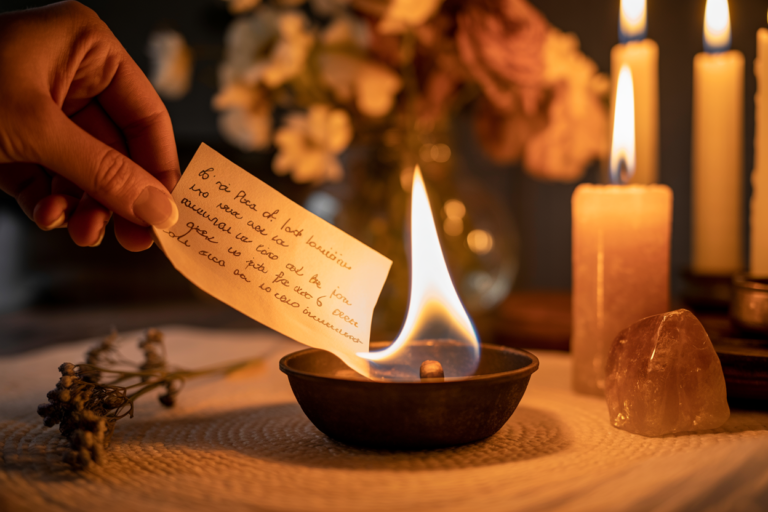
The practice: Choose one forgiveness letter to write — one person, one situation, one aspect of your body or yourself. You will not send this letter. Write without editing. Begin with the truth of what happened and what it cost you — do not rush to the forgiveness, let the truth come first. Then, when you are ready, write toward the release: not “I forgive you and everything is fine” but something more honest, like “I am choosing to stop letting this live in me. I am releasing the hold this has on my heart. Not because it didn’t matter, but because I need the space for other things.”
After writing, you may keep the letter, burn it with intention, tear it up, or release it however feels right. The healing happens in the writing, not in what you do with the paper afterward.
Accessible version: If writing a full letter isn’t available, write one sentence. “I am releasing the hold [this] has on my heart.” One sentence, written with presence and intention, is a complete heart chakra practice. The length is not what makes it real.
Conscious receiving as daily practice
For people whose heart chakra wound includes the receiving dimension — the difficulty of accepting care, help, or love without guilt — conscious receiving is its own practice. This looks like: accepting a compliment without immediately deflecting it. Letting someone help without insisting you don’t need it. Receiving rest without justifying it. Receiving care from others — a meal brought, an errand run, a moment of gentleness — with a full, open “thank you” rather than an apology for needing it.
For people who have spent years minimizing their needs, receiving openly is a profound act of heart chakra healing. It says: I am worth caring for. My needs are legitimate. Love offered to me does not need to be earned or immediately returned.
Tools for your heart chakra practice

A soft green or rose-toned candle lit during heart chakra meditation, letter writing, or conscious rest activates the chakra’s color resonance and creates the quality of warmth and gentleness that heart chakra work requires. The act of lighting it with intention — this time is for my heart, this space is for healing — is itself a practice. Green for healing and growth; pink for self-love and tenderness. Choose whichever calls to you on any given day.
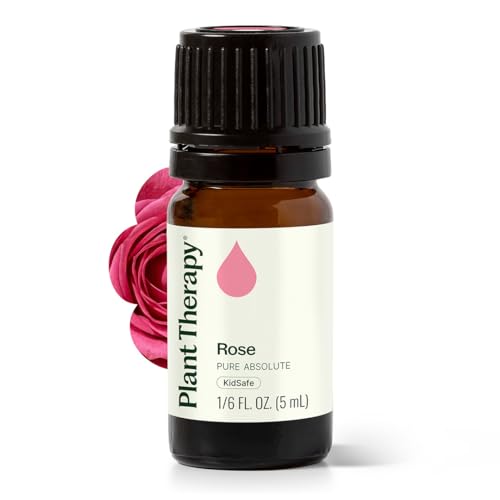
Rose essential oil is the most traditionally heart-aligned scent available — associated with love, grief, and the opening of the heart across cultures and traditions. Geranium is emotionally balancing and specifically associated with forgiveness and healing old wounds. Bergamot is uplifting and gently opening — useful on the days when the heart work feels too heavy and needs lightening before it can deepen. Diffuse during practice or dilute in a carrier and apply over the center of the chest.

A weighted eye pillow placed over the eyes during heart chakra meditation supports the quality of surrender and opening that this practice requires. The gentle pressure activates the parasympathetic nervous system, and blocking light creates the interior darkness in which emotional truth tends to surface more readily. The heart chakra’s work often happens best in the dark — in the quiet space between the external world and the internal one.

Rose tea carries the heart chakra’s primary botanical resonance — used in traditional herbalism specifically for grief, emotional pain, and the opening of a closed heart. Hawthorn berry is the cardiovascular herb of Western herbalism, associated with heart health both physically and emotionally. Lemon balm is gently calming for nervous system overwhelm. A warm cup of any of these, drunk with presence during or after heart chakra work, extends the practice into the body in the most literal way.
Crystals and ritual tools for the heart chakra
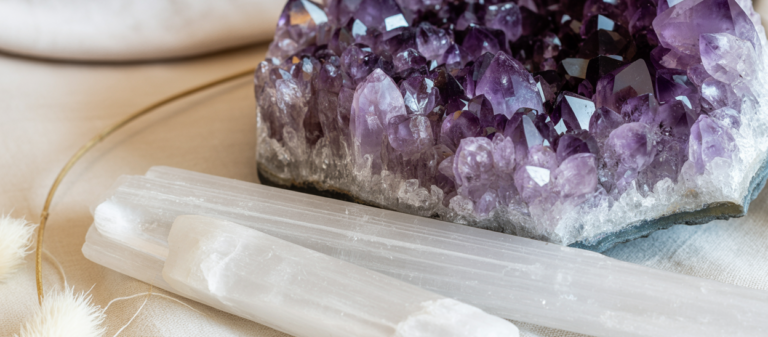
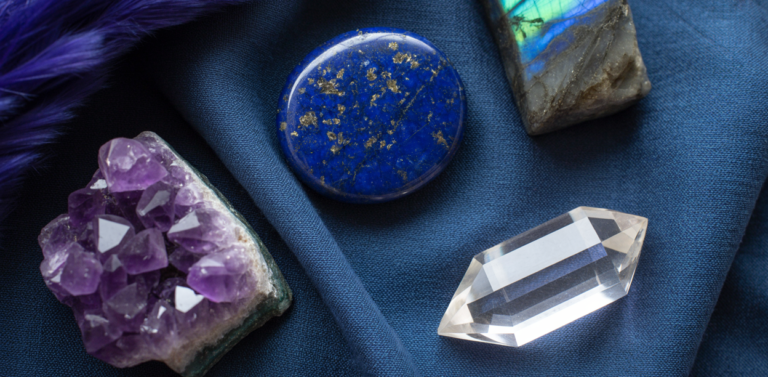
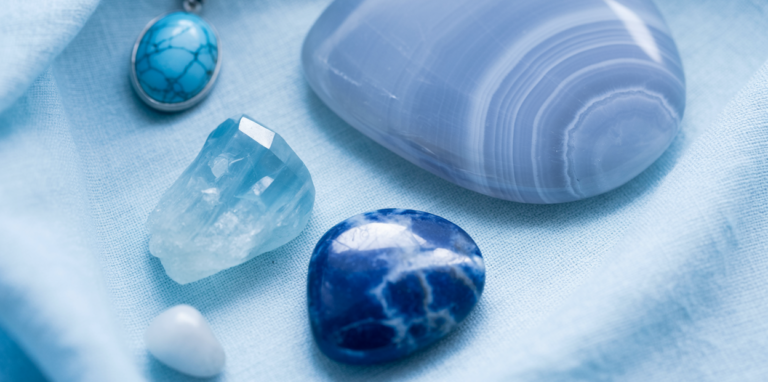
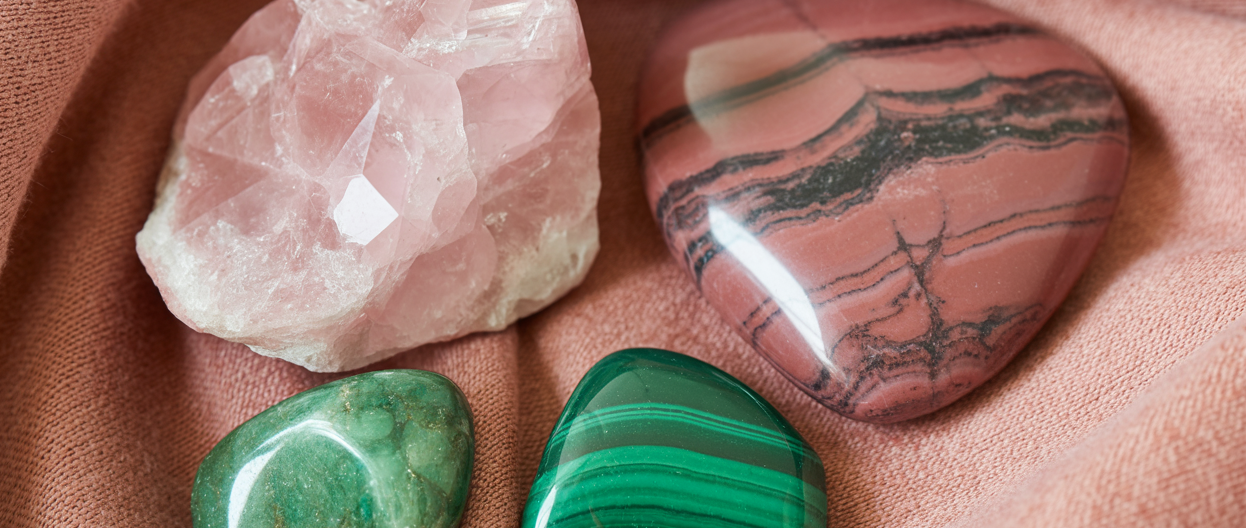
The heart chakra’s crystal palette spans green and pink — healing and love, growth and tenderness. These are some of the most beautiful and most widely available crystals in the system, and their softness and warmth makes them deeply suited to the quality of gentleness that heart chakra work requires. These are not crystals of force or activation — they are crystals of opening, of softening, of creating the conditions in which what has been closed can begin, slowly and on its own terms, to open.
Rose quartz is the heart chakra’s most recognized crystal — the stone of unconditional love, of self-compassion, of the particular tenderness that is available to us when we stop demanding that we be different from what we are. For chronic illness bodies that have a complicated relationship with self-love, rose quartz offers a gentle, non-demanding quality of compassion that doesn’t require anything to be resolved or better before it is available. It simply holds the quality of love — of being held, being warm, being okay — and allows the body to receive that quality through contact and proximity. Keep a piece on the nightstand, hold it during difficult moments, place it on the chest during meditation.
Green aventurine is the heart chakra’s healing crystal — associated with emotional recovery, the clearing of old patterns, and the quality of luck and possibility that comes when the heart is open rather than contracted. For people who have carried grief and resentment for a long time, green aventurine offers the energetic quality of a clearing — not forcing release, but creating the conditions in which release becomes more possible. It is also specifically associated with soothing anxiety, which is a significant companion of heart chakra wounding in chronic illness.
Rhodonite is the crystal of compassion and emotional balance — associated specifically with forgiveness and the healing of old emotional wounds. What makes rhodonite distinct from rose quartz is its quality of balance rather than just softness: it holds both the love and the wound simultaneously, in the way that genuine forgiveness does. It does not bypass the pain in the rush to feel better. It acknowledges what happened and holds it with compassion. For anyone working specifically on forgiveness — of the body, of others, of themselves — rhodonite is the more appropriate stone than rose quartz.
Malachite is the transformation stone — deep green with distinctive banding, associated with processing and releasing emotional pain at depth. It brings what has been buried to the surface so it can move. Work with it carefully and in small doses; it amplifies whatever is present, which is powerful when you’re ready and overwhelming when you’re not.
Emerald is the heart chakra’s crystal of wisdom — associated with love seasoned by experience and difficulty. For people whose chronic illness journey has been long, emerald’s quality of mature, earned love is specifically resonant. This is not the love of a life without pain. It is the love that persists through and alongside the pain, which is a different and more durable thing.
Heart chakra crystals worth adding to your practice

The foundational heart chakra crystal — available at every price point and in every size, making it the most accessible entry point for crystal practice generally. A substantial piece for the nightstand or altar where it can be seen daily, and a smaller tumbled piece for holding during difficult moments. Rose quartz works through proximity as much as through active practice — simply having it visible in the spaces where you rest and sleep creates a consistent, gentle heart chakra presence.
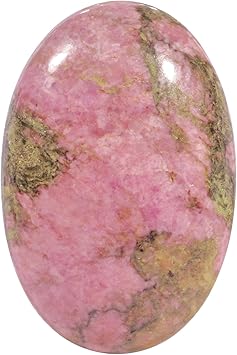
A smooth rhodonite palm stone for forgiveness work specifically — the distinctive pink-and-black pattern makes it immediately recognizable, and its weight in the hand is grounding during the emotional work of writing forgiveness letters or sitting with difficult feelings. Keep it with the journal used for heart chakra work.

Green aventurine for emotional clearing and anxiety soothing — placed in the pocket for difficult appointments, held during breathing practices, or positioned on the chest during lying-down meditation. Its soft, gentle green energy makes it one of the most universally well-tolerated heart chakra crystals — less intense than malachite, less specifically grief-focused than rhodonite, simply consistently supportive.
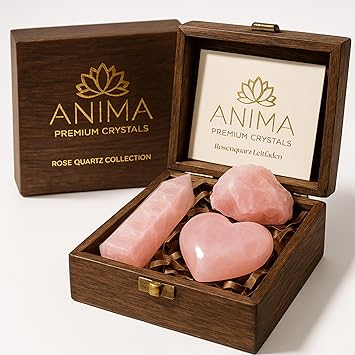
A curated heart chakra set covering the full range of this chakra’s crystal support — self-compassion (rose quartz), emotional clearing (green aventurine), forgiveness work (rhodonite), and deep transformation (malachite). Look for sets where pieces are substantial rather than chips, with at least one piece large enough for altar display and smaller pieces for carrying and meditation placement.
Journaling prompts for the heart chakra
Heart chakra journaling goes to the most tender places — the body relationship, the grief, the forgiveness, the receiving. These prompts are designed to be approached with gentleness. You do not need to feel loving to begin them. You need only to be willing to look honestly at what is there. Write without editing, without performing, without trying to arrive at the “right” emotional conclusion. The heart speaks in the first draft.
Some of these prompts will be straightforward. Some will require more courage. Let yourself take them slowly — one prompt per sitting is enough, particularly for the grief and forgiveness questions. These are not prompts for efficiency. They are prompts for depth.
For the body relationship:
- What is my honest, unfiltered relationship with my body right now? Not what I think it should be — what it actually is?
- What has my body been through that I haven’t fully acknowledged or honored? What does it deserve credit for?
- If I spoke to my body the way I speak to someone I love, what would I say to it right now?
- What would it feel like to be at peace with this body — not free of illness, but genuinely at peace alongside it?
For grief:
- What have I lost to chronic illness or pain that I haven’t fully let myself grieve?
- What version of my life or myself am I still mourning?
- What would it mean to honor this grief rather than manage it — to let it be as big as it actually is, at least for a moment?
- What would I want to say to the version of myself that existed before this illness? What would that person need to hear?
For forgiveness:
- What unforgiveness am I carrying — toward my body, toward others, toward myself — that is taking up space in my heart?
- What would it cost me to release that unforgiveness? What would it free up?
- Is there something I need to forgive myself for — a way I have been unkind to myself, a standard I have held myself to that was never fair given what I was managing?
- What would forgiveness look like in my specific situation — not the generic version, but the honest, imperfect version available to me?
For receiving and self-love:
- How comfortable am I with receiving — care, help, love, rest? Where does the discomfort come from?
- What would I offer to someone I loved deeply who was in my situation? Why is it difficult to offer that same thing to myself?
- What does self-love actually look like for me right now — not the aspirational version, but the version that is available in this body, on this day?
For your heart chakra journaling practice

A dedicated heart chakra journal in a soft, warm tone — dusty rose, sage green, or warm blush — that holds the tenderness this work requires. The cover color matters for the heart chakra specifically: you should want to pick this journal up, even when the work inside is difficult. Lay-flat binding for ease. This journal holds the deepest work of the series — the grief, the forgiveness, the body relationship — and should feel like it belongs to something worth tending.

Forgiveness letters written on paper that feels substantial — thicker than standard notebook paper, with a quality that signals the writing matters — changes the quality of the practice. Something about writing a forgiveness letter on beautiful paper makes the act feel more ceremonial, more intentional, more real. These can be burned, buried, or kept — the paper’s quality makes any of those endings feel appropriate.

A few minutes of palo santo or rose-scented incense before heart chakra journaling creates a ritual transition into the tender space this work requires. Rose incense specifically carries the heart chakra’s botanical resonance into the air of the practice space, making the environment actively supportive of the emotional opening the prompts invite. Use in a ventilated space, and allow the scent to settle before beginning.

Heart chakra journaling sometimes needs to happen from a lying-down or semi-reclined position — the body may need to be horizontal, held by a surface, before the heart can open. A cushioned lap desk that creates a stable writing surface from any position removes the postural requirement that can make this practice feel inaccessible on the days when the heart work is most needed.
Affirmations for the heart chakra
Heart chakra affirmations for the chronic illness and pain body are designed for the specific wounds of this energy center — the body relationship, the grief, the receiving difficulty, the forgiveness work, and the kind of self-love that is not performance but persistence. They are honest rather than aspirational. They do not ask you to feel loving when you don’t. They ask you to practice the direction of love — toward the body, toward yourself, toward the complicated life you are actually living — and to trust that the feeling follows the practice more often than it precedes it.
Say them with your hands on your chest if possible. Feel them in the sternum rather than the head. Say them gently — the heart chakra responds to softness, not force. On the days when they feel furthest from true, say them most.
- I am allowed to grieve what chronic illness has taken. My grief is real and it deserves to be honored.
- I am learning to love my body — not despite what it has put me through, but as the thing that has carried me through it.
- I release the unforgiveness I have been holding. Not because it didn’t matter, but because I need the space for other things.
- I am worthy of care. I am worthy of love. I do not need to earn either.
- I am allowed to receive — help, rest, love, tenderness — without apology and without guilt.
- I forgive myself for every plan I couldn’t keep, every commitment illness made impossible, every way I couldn’t be who I wanted to be.
- My heart has not been broken by everything that has tried to break it. It is still open. It is still here.
- I am compassionate with myself — not perfectly, not always, but more than I was yesterday.
- I love this life, even in its altered form. I love myself through the alteration.
- I am Anahata — unstruck at the deepest level. Whatever has touched me has not destroyed what I am.
Opening your heart to yourself is one kind of love. Speaking up for yourself in the rooms where your health gets decided is another expression of that same love. Say This: 30 Scripts for Chronic Pain Communication gives you the language for 30 real situations — because the most loving thing you can do for yourself in the medical system is show up prepared, speak clearly, and insist on being heard. Get your copy of SAY THIS here
For creating your heart chakra ritual space

A soft-toned altar tray for the heart chakra arrangement — rose quartz, a green or pink candle, a small vase of fresh flowers, an affirmation card, rhodonite beside the journal. The tray defines the practice space as intentional and tender. Return to it daily, even for a moment. The returning is the practice as much as anything done within it.

A singing bowl with a warm, resonant tone to open and close heart chakra sessions. Sound is particularly well-suited to the heart chakra because it moves through and within the chest — you can feel a well-struck singing bowl in the sternum, which is precisely the area being worked with. Let the sound settle completely before beginning practice and once more at the close.

Roses are the heart chakra’s flower — their beauty, their scent, and their traditional association with love across virtually every culture make them the most complete botanical expression of this energy center. Fresh roses on the altar or beside the practice space activate the heart chakra visually and through scent. Dried rose petals scattered around a candle arrangement on the altar are beautiful and long-lasting between fresh arrangements.

A warm bath with Epsom salt and a few drops of rose or geranium essential oil is one of the most complete heart chakra healing rituals available — warm water for the body, magnesium for pain and muscle relief, and heart-aligned scent all working together. The bath holds you in the way the heart chakra is meant to hold you: warmly, without demand, as long as you need. This practice belongs in the heart chakra toolkit specifically for the hardest days — the days when the grief is loudest and the body most needs to be held by something warm.
Unstruck
The Sanskrit name for the heart chakra — Anahata — means unstruck. Not untouched, not free of pain, not unaffected by everything that has happened. But unstruck at the deepest level. Still essentially whole beneath everything that has tried to break it.
Chronic illness and pain have touched your heart in ways that are real and significant. The grief is real. The damaged body relationship is real. The accumulated unforgiveness — of the body, of systems that failed you, of yourself — is real. The difficulty receiving love without guilt is real. None of these are being minimized.
Underneath all of it, something has not been struck. A capacity for love that has persisted. The love you have given imperfectly, at significant cost, through pain and grief and all the rest — that love is evidence of your heart chakra’s essential aliveness, even when it has felt most closed.
The work is not to manufacture love you don’t feel. It is to clear enough of what has accumulated — the grief, the unforgiveness, the closed receiving — that the love underneath has room to move. It is already there. The heart chakra practices are simply the work of making room for it again.
Start with your hands on your chest and five slow breaths. That is the beginning. Everything else follows from there.
From the love and forgiveness of the heart — from the opened chest, the honored grief, the reclaimed capacity to receive — we move next into the territory of voice. The throat chakra is where the question becomes not how you love but how you speak: how you find and use the voice that illness and dismissal have taught you to make smaller, and how you reclaim the right to be heard.
Next in the LOVEOWE Chakra Series: The Throat Chakra — Finding Your Voice Again After Chronic Illness Has Made It Smaller