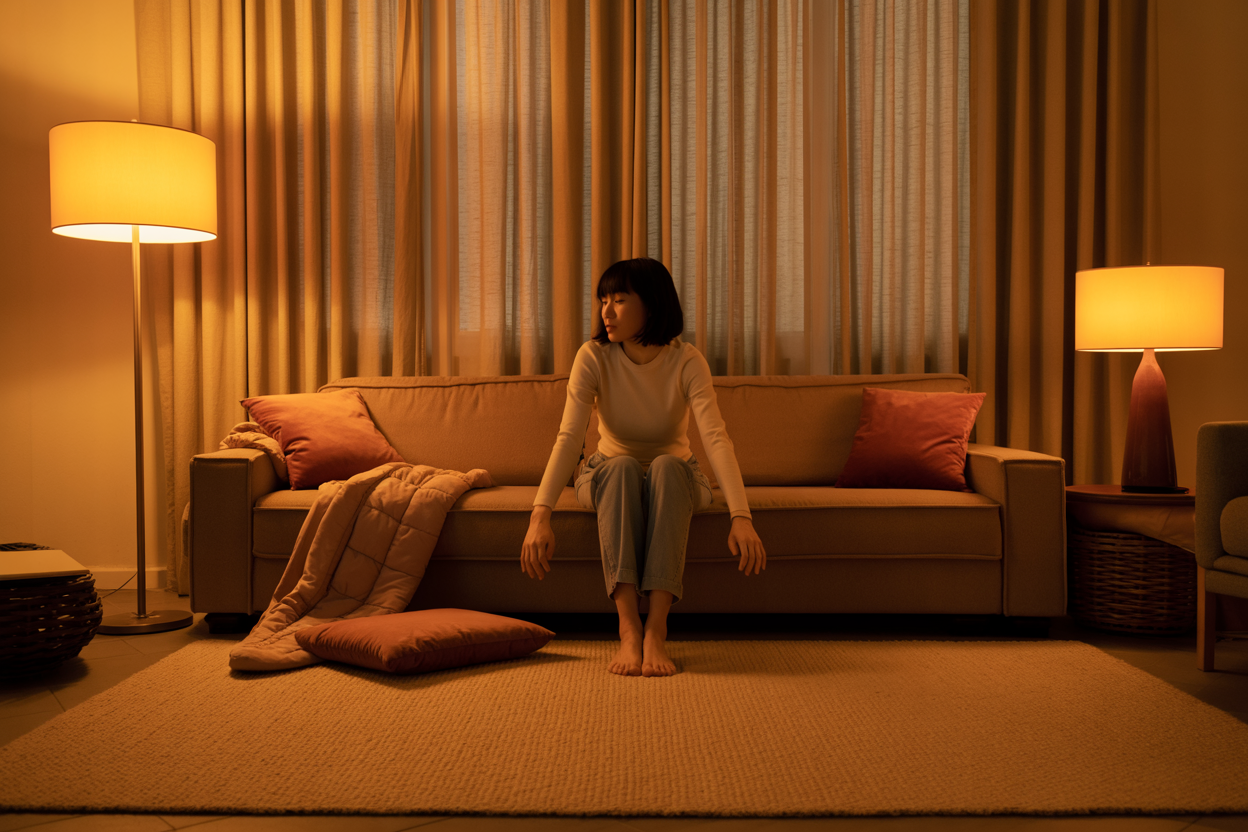
Sensory-Friendly Home Decor: How to Design a Space That Calms Your Nervous System Instead of Taxing It
The content on this site was created with the help of AI. LOVEOWE LLC participates in the Amazon Services LLC Associates Program and other affiliate programs. As an Amazon Associate, I earn from qualifying purchases. This means I may earn a small commission—at no extra cost to you—when you make a purchase through links on this site. All opinions are my own. Learn more click here. Thank you for your support!
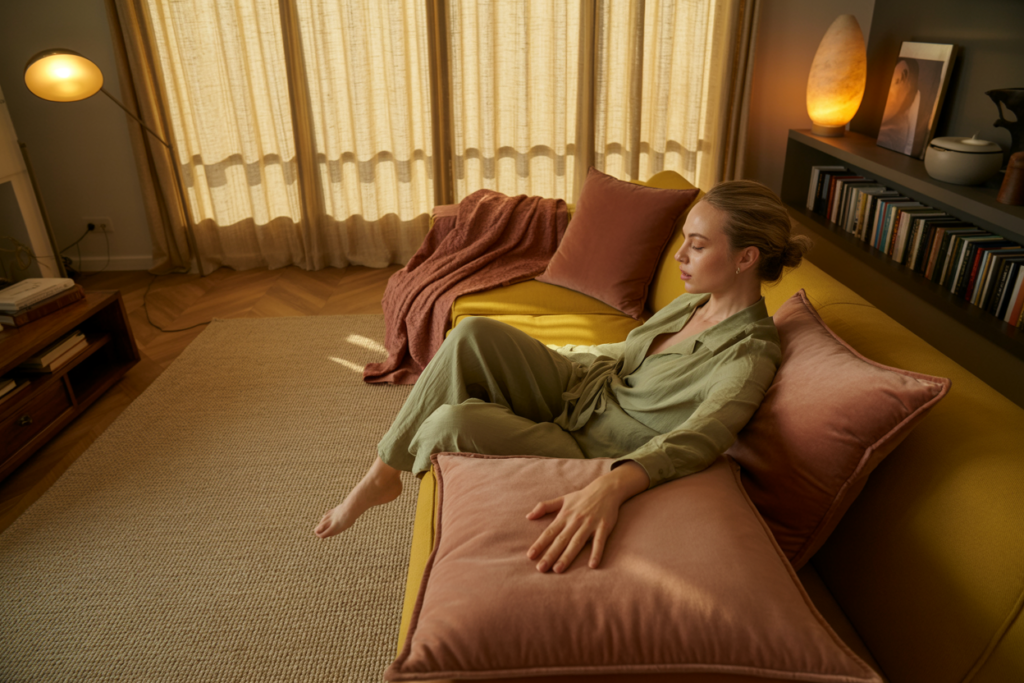
I didn’t know my home was making me worse until I spent two weeks somewhere else.
It was a rental — nothing special, nothing designed with any particular intention — but it was quieter than my apartment in a way I couldn’t immediately explain. The windows had heavy curtains that blocked the afternoon light. The floors had a large, low-pile rug that absorbed the sound of footsteps. The overhead light fixture was missing a bulb, so the room ran dim and warm from a single lamp in the corner. I slept better in that rental than I had in months. I moved through the days at a different pace. My nervous system, which I had grown so accustomed to managing that I’d stopped noticing the effort it required, went quiet in a way that felt almost unfamiliar.
When I got home, I stood in my living room and really looked at it for the first time. The overhead light was bright and cool and hit every surface without softness. The floors were bare wood that turned every footstep into an event. The windows had thin curtains that let in the full force of the afternoon sun. The throw pillows were a stiff, woven fabric that looked beautiful and felt like burlap against bare arms. Nothing was wrong with any of it, technically. It was a fine room. It was just a room that had never once been designed with my nervous system in mind.
That distinction — between a room that is fine and a room that actively supports you — is what this post is about.
For people navigating chronic illness, fibromyalgia, lupus, POTS, multiple chemical sensitivity, anxiety, PTSD, autism, ADHD, or any condition that affects sensory processing, the home environment is not a neutral backdrop. It is a constant input. Every light source, every texture, every sound your space generates or amplifies is information your nervous system has to process — and when your nervous system is already working overtime managing pain, inflammation, or dysregulation, that environmental load matters enormously. It is the difference between a home that helps you recover and one that quietly prevents it.
This post is the guide to building the second kind of home. We are going to cover every major sensory category — light, sound, texture, scent — and the specific decor choices that address each one. Not a clinical guide, not a list of accommodations. An elevated, intentional, genuinely beautiful approach to designing a home that your body can actually rest in.
Understanding Sensory Load: Why Your Home Environment Affects Your Health More Than You Think
The nervous system processes everything. Every flicker of a fluorescent light, every hard surface that bounces sound around a room, every scratchy fabric that your skin registers as low-grade friction — all of it moves through the same system that is also managing your pain signals, your inflammation response, your fatigue, and your emotional regulation. When that system is healthy and well-resourced, it handles environmental input in the background without much cost. When it is already stretched — which is the baseline for most people with chronic illness — environmental input stops being background and starts being foreground.
This is why a bad pain day can be made significantly worse by a noisy room, bright lighting, or the wrong fabric against skin. It is also why the inverse is true: a thoughtfully designed environment can actively reduce the load on an already-taxed nervous system, freeing up resources for healing, rest, and simply getting through the day.
The goal of a sensory-friendly home is not to eliminate all sensation — that is neither possible nor desirable. The goal is to reduce unnecessary sensory noise: the inputs that serve no purpose except to demand processing. Harsh overhead lighting that could be replaced with warm, diffused lamps. Hard surfaces that amplify sound when soft surfaces would absorb it. Synthetic fabrics that create friction when natural alternatives would lie quietly against skin. The changes are often small. The cumulative effect is not.
Light: The Fastest Way to Change How a Room Feels
Light is the single most impactful variable in a sensory-friendly home, and it is also the one most people haven’t touched since they moved in. The default in most homes — overhead fixtures with cool-toned bulbs at full brightness — is essentially the worst possible configuration for a sensitive nervous system. Cool light (above 4000K color temperature) activates the brain’s alertness response. Overhead light creates harsh shadows and eliminates the softness that comes from varied light sources at different heights. Full brightness leaves nowhere for the eyes to rest.
The shift is straightforward: move light down and warm it up. Replace overhead fixtures as your primary light source with lamps positioned at standing and table height. Switch to bulbs in the 2700K to 3000K range — warm white rather than cool white or daylight. Add dimmers wherever possible so you can adjust light levels to match your capacity on any given day. On high-sensitivity days, warm lamplight at low levels may be the only light source your nervous system can tolerate without cost. Design for that day, not just the average one.
For windows, the goal is control rather than elimination. Blackout curtains give you the option of complete darkness when you need it — during a migraine, a flare, a rest that has to happen in the middle of the afternoon — without requiring you to live in the dark. Layering sheer curtains beneath blackout panels gives you a full range: filtered natural light when you can tolerate it, complete darkness when you can’t.
The Lighting Edit: Warm, Layered, and Fully in Your Control
These four pieces form the foundation of a sensory-friendly lighting environment — warm sources, adjustable levels, and the ability to control your light the way you control everything else in your healing space.

A tall, warm-toned floor lamp that can be adjusted from full brightness to near-darkness via app or remote — no getting up, no fumbling with a switch on a hard day. The color temperature is adjustable from warm white to soft warm, which means you can shift the light in your room to match what your nervous system needs at any hour. Slim profile, minimal design, and warm enough in its lowest setting to make a room feel like candlelight.

The most flexible lighting upgrade available for a sensory-sensitive home. Philips Hue bulbs screw into any standard fixture and connect to an app that lets you adjust color temperature and brightness from your phone — or set automated schedules so your lights warm and dim as the day progresses without you having to think about it. For people whose light sensitivity fluctuates with their condition, the ability to adjust light without leaving the couch is genuinely functional, not just convenient.

The non-negotiable for migraine, light sensitivity, afternoon sun flooding, and any sleep that needs to happen outside of nighttime hours. Look for blackout curtains in a linen-look fabric rather than the flat synthetic blackout panels — they read as elevated and intentional rather than clinical, and they layer beautifully with sheers for a full range of light control. Hang them as high and wide as possible to maximize both coverage and the visual effect of taller, larger windows.

The warmest, most organic light source available for a healing space. Salt lamps emit a soft amber glow at a color temperature so warm it registers more as firelight than electric light — the kind of light that the nervous system reads as evening, as safety, as time to begin unwinding. The dimmer cord gives you control over how much light it puts out. Not a primary light source, but an exceptional secondary one for the hours when you are actively trying to bring your nervous system down.
Sound: The Sensory Variable Most Home Decor Ignores Completely
Hard surfaces are acoustically aggressive. Bare wood or tile floors, plaster walls, uncovered windows, minimal furniture — all of it reflects sound rather than absorbing it, which means every noise in the room bounces until it lands on your ears. In an apartment or open-plan space, this effect multiplies: footsteps become percussive events, conversations carry across rooms, the ambient noise of a city or a building comes through walls with almost nothing to soften it.
For people with noise sensitivity — which includes a significant portion of the fibromyalgia, migraine, PTSD, and autism communities — this acoustic environment is exhausting in a way that is hard to explain to someone who doesn’t experience it. It is not that the sounds are unpleasant, exactly. It is that they are constant, unavoidable, and require the nervous system to continuously process and dismiss them, which costs energy that could be going toward literally anything else.
The solution is soft surfaces — and more of them than you think you need. Rugs on hard floors. Curtains on windows. Upholstered furniture rather than wood or metal frames. Bookshelves full of books, which absorb sound more effectively than most people realize. Throw blankets draped over surfaces. Cushions stacked in corners. These are not decorating choices that happen to reduce sound. They are acoustic interventions that happen to look like decorating choices.
Beyond soft surfaces, a white noise machine or sound conditioner is one of the highest-return additions to a sensory-sensitive home. Not to add sound, but to create a consistent audio baseline that makes intermittent noises — a neighbor, a passing car, a door closing somewhere in the building — land against a buffer rather than in sudden contrast to silence. The nervous system responds to sudden sound changes more strongly than to continuous sound. A white noise machine smooths those spikes.
The Sound Edit: Soft Surfaces, Acoustic Tools, and the Quiet You Deserve
These four address sound from different angles — the soft surfaces that absorb it, the tools that buffer it, and the additions that make a room acoustically gentler without changing how it looks.

The most consistently recommended white noise machine in chronic illness and sensory sensitivity communities. Ten fan sounds and ten white noise variations, all non-looping — meaning there is no repeating pattern for a sensitive brain to track and fixate on. The volume range is wide enough to cover significant ambient noise. Compact enough to move between rooms, bedroom to living room, wherever you need it most on a given day.

The single most effective acoustic intervention in a hard-floored room. A large area rug — and it needs to be large, covering the majority of the floor rather than floating in the center — absorbs footstep impact, reduces echo, and creates a visual anchor that makes a room feel contained and settled. Low pile is preferable for sensory sensitivity: high-pile or shag rugs can create their own texture overwhelm and are harder to keep clean, which matters for people managing dust or allergen sensitivity.

For rooms where sound is particularly problematic — home offices, bedrooms that share walls, open-plan living spaces — acoustic panels absorb sound at the wall level before it has a chance to bounce. Decorative felt panels in geometric shapes have moved firmly into the design mainstream and look intentional rather than functional. Mount them in a cluster above a desk, along a long wall, or behind a bed as a soft alternative to a traditional headboard.

For the moments when the environment cannot be controlled — a noisy building, a family visit, a day when sound sensitivity is particularly acute — Loop’s Quiet earplugs reduce ambient noise by up to 27 decibels without the discomfort or full blockage of foam earplugs. The smooth silicone tip sits in the ear canal gently enough to wear for hours, and the design is minimal enough that wearing them doesn’t feel clinical or conspicuous. A portable sensory tool that belongs in every chronic illness home.
Texture: Designing for Skin That Already Has Enough to Manage
Texture in home decor is usually discussed as a purely visual concept — the way layering different materials adds depth and interest to a room. For people with tactile sensitivity, it is also a physical one. The fabric on your sofa is against your arms and legs for hours every day. The pillowcase on your bed is against your face every night. The rug under your feet communicates texture with every step. These surfaces are not neutral. They are either adding to your sensory load or they are not.
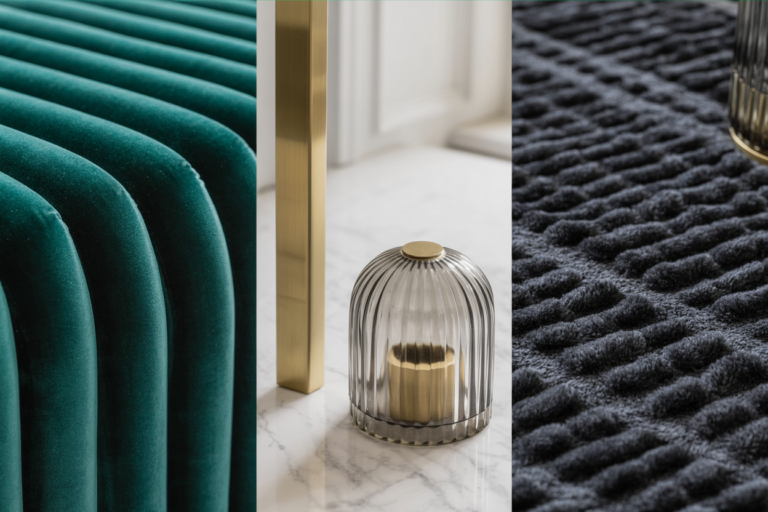
The principle for a sensory-friendly home is softness without sacrifice. Natural fibers — linen, cotton, wool, silk — tend to feel more compatible with sensitive skin than synthetics because their fibers are smoother and less likely to create the static and friction that synthetic fabrics generate. Within natural fibers, weight and weave matter: a loosely woven open linen is rougher than a tightly woven one. A chunky knit wool is more texturally aggressive than a fine merino. A velvet — which reads as maximally tactile — is actually one of the softest surfaces available because the pile lies in one direction and creates almost no friction against skin.
The visual principle of texture layering still applies — a room that reads as flat and uniform is aesthetically empty regardless of how sensory-friendly it is. The goal is to layer textures that are visually interesting without being physically demanding: smooth linen, soft velvet, fine knit, natural wood with a satin finish. All of them can be touched without cost. All of them look layered and intentional. None of them are asking anything of a nervous system that is already working.
Designing your home around your nervous system is one form of self-advocacy. Communicating your needs to the people in your life is another.
If you have ever struggled to explain why certain environments are genuinely difficult for you — to a doctor who dismisses sensory sensitivity, a family member who doesn’t understand why you need the lights lower, a workplace that doesn’t accommodate — Say This: 30 Scripts for Chronic Pain Communication gives you the language. Thirty ready-to-use scripts for the conversations that matter most, written for exactly the moments when you know what you need and cannot find the words to make someone else understand it.
The Texture Edit: Soft Furnishings That Layer Beautifully and Feel Like Nothing at All
These four address the tactile environment of a sensory-sensitive home — the surfaces you live against every day, chosen for how they feel as much as how they look.

The weighted blanket belongs in a sensory-friendly home for a reason that goes beyond comfort: deep pressure stimulation — the gentle, even weight of a heavy blanket across the body — activates the parasympathetic nervous system, shifting the body from a state of alertness toward one of rest. For people whose nervous systems run in a chronic state of low-grade activation, this shift is not a luxury. It is a physiological intervention. Look for a cooling cotton cover rather than fleece for people who run warm or have temperature sensitivity.

Velvet is the most sensory-friendly decorative fabric available — its short, directional pile creates a surface that the hand moves across smoothly rather than catching against. Earth tones — terracotta, moss, camel, dusty rose — are visually calming in a way that cooler, higher-contrast colors are not, and they photograph beautifully as part of a layered, grounded home aesthetic. Replace any woven, nubby, or scratchy throw pillows with velvet covers and notice how differently the room feels to be in.

Washed linen is the textile equivalent of a deep exhale. The washing process softens the natural linen fiber to a point where it has the tactile quality of something that has been worn and loved for years — no break-in period, no scratchy newness. It is breathable enough for temperature sensitivity, heavy enough to feel substantial without weight, and natural enough in its composition to be compatible with reactive or easily irritated skin. The bedroom is where your body does its most critical recovery work. What you sleep under matters.

For visual texture that reads as warm and layered without the tactile aggression of a rough knit. A merino wool blend chunky knit has the visual weight of a substantial throw while remaining soft enough to touch with sensitive skin — merino is one of the finest natural wool fibers, with a micron count low enough that it does not trigger the prickling response that coarser wool does. Chenille is an excellent, vegan, and pet-friendly alternative to merino wool, especially if you need a soft texture that holds up well in the washing machine. Drape it over the arm of a sofa or folded across the foot of a bed for the layered, grounded aesthetic that reads immediately as intentional and restful.
Scent: The Sensory Variable That Can Heal or Harm in the Same Breath
Scent is the most complex sensory variable in the home environment because it is the one most likely to help and most likely to harm, depending entirely on the individual and the specific product. For people with multiple chemical sensitivity, fragrance allergy, migraine, or mast cell activation, synthetic fragrance — in candles, cleaning products, air fresheners, plug-ins, and heavily fragranced personal care products — is not a preference issue. It is a trigger. It can initiate a cascade of symptoms that has nothing to do with how pleasant the scent smells.
The sensory-friendly approach to scent starts with elimination: remove all synthetic fragrance sources from the home environment. Unscented cleaning products, fragrance-free laundry detergent, no plug-in air fresheners, no synthetic candles. This is the baseline. From there, some people find that natural scent sources — pure essential oils, beeswax candles, fresh herbs and plants — are tolerable or even therapeutic, while others need to remain fully fragrance-free. The key is knowing your own threshold and designing for it, not for a generalized version of aromatherapy that was never built with sensitivity in mind.
For those who can tolerate natural scent, the choices matter. Lavender and chamomile have documented nervous system effects — they genuinely shift the body toward parasympathetic activation in ways that synthetic lavender fragrance does not. Eucalyptus has anti-inflammatory properties when diffused at low concentrations. Frankincense has been used for centuries in healing contexts and has a grounding, slowing quality that many people find specifically helpful during pain or anxiety spikes. These are not air fresheners. They are functional additions to a healing environment, used with the same intentionality as everything else in a sensory-friendly home.
The Scent and Air Quality Edit: Clean, Intentional, and Genuinely Functional
These four address the invisible environment of a sensory-sensitive home — the air quality, scent, and atmospheric conditions that affect how your body feels in a space even when everything looks exactly right.

For people with chemical sensitivity, dust sensitivity, mold reactivity, or any respiratory component to their chronic illness, air quality is not a wellness upgrade — it is a foundational requirement. The LEVOIT Core 300 uses a genuine three-stage HEPA filtration system that captures particles down to 0.3 microns, including dust, pollen, pet dander, and VOCs from synthetic materials and cleaning products. Quiet enough to run continuously in a bedroom without adding to noise load. One of the highest-value additions to a sensory-sensitive home.

For those who tolerate natural scent, a diffuser is the most aesthetically considered option in its category — a vessel that looks like a decor object rather than a wellness appliance. Pair it with single-ingredient essential oils — pure lavender, frankincense, or eucalyptus from a reputable source — rather than blends, which are harder to assess for individual tolerance. Run it for thirty minutes rather than continuously for a therapeutic effect without accumulation.

For people who cannot tolerate any fragrance but still want the specific quality of light that a candle creates — that warm, flickering, living light that the nervous system reads as fundamentally different from electric light — unscented beeswax candles are the answer. Beeswax burns cleaner than paraffin, produces no synthetic fragrance, and emits a light that is warmer and more golden than almost any bulb. The light alone is the point. It does not need to smell like anything.

The final layer in a sensory-friendly room is the quality of natural light that moves through it. Synthetic sheer curtains filter light adequately but create a slightly cool, flat quality that does nothing for a room’s warmth. Organic cotton or linen sheers filter light into something softer and more golden — the kind of light that makes a room feel like it’s held rather than exposed. Layer them beneath your blackout panels for a daytime environment that is bright enough to function in but soft enough to rest in.
Putting It Together: The Sensory-Friendly Room, Layer by Layer
You do not need to redesign everything at once. The sensory-friendly home is built in layers, starting with the changes that will have the most immediate impact on your nervous system and working outward from there.
Start with light. Swap one overhead bulb for a warm lamp. Add a dimmer to a fixture you use every day. Hang blackout curtains in your bedroom. These changes cost very little and their effect on how a room feels is immediate and significant.
Then address sound. A white noise machine in your bedroom costs less than most people spend on a single decorative object and will change the quality of your sleep and your rest more than almost any other single purchase. Add a rug to your hardest-floored room if you don’t have one. Close the acoustic loop on your most-used space.
Then move through texture, slowly and intentionally. Replace one scratchy thing with something softer. Add a weighted blanket to your sofa. Put a velvet cover on the pillow you reach for most. Let your skin start having less to manage and notice what that frees up.
Last, address the air. Remove the synthetic fragrance sources first — that is always the starting point. Then add what supports you: an air purifier if air quality is part of your picture, a diffuser with a single oil if natural scent is therapeutic for you, unscented beeswax candles if what you need is warmth and light.
The home you are building is not a medical environment. It is not a sensory deprivation chamber. It is a place where your nervous system gets to set the terms — where the inputs have been chosen with your body in mind rather than despite it. Where the light is warm because warm light costs you less. Where the surfaces are soft because soft surfaces ask nothing of skin that is already working hard. Where the air is clean because clean air is one less thing to manage.
That home is not a luxury. It is not an aesthetic project. It is one of the most direct, practical, and lasting investments you can make in your own healing — built one thoughtful choice at a time, exactly at the pace your body allows.
You deserve a home that works for you. Start there. Build from there. Your nervous system will tell you when you’re getting it right — not with a dramatic shift, but with a quiet one. The kind where you realize, halfway through an afternoon, that you forgot to brace for the next hard thing. That the room you are sitting in asked nothing of you today.
That is what we are building. That is what you deserve.
You’ve started designing a home that supports your body. Now let’s make sure the people around you understand what that support needs to look like.
If you’ve ever had to explain your sensory sensitivity to someone who didn’t take it seriously — a doctor, a family member, a colleague who thinks you’re being difficult — Say This: 30 Scripts for Chronic Pain Communication gives you the exact words. Thirty scripts for thirty hard conversations, written for the moments when you know what your body needs and the people around you don’t yet understand why it matters. Because advocating for a healing environment starts at home, and it doesn’t end there.